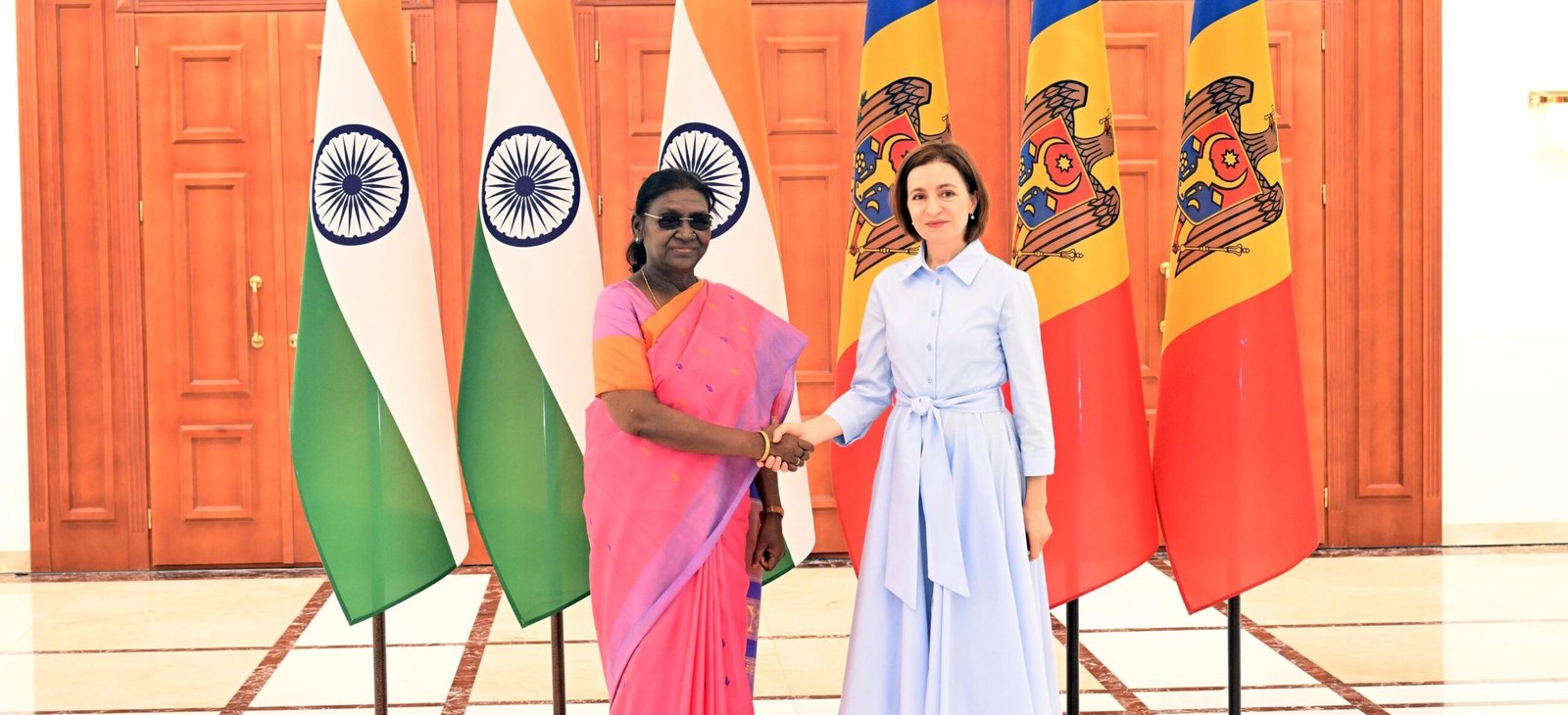
President Droupadi Murmu received a ceremonial welcome in Moldova during the first-ever state visit by an Indian head of state to the Eastern European nation, marking a significant diplomatic milestone in bilateral relations between New Delhi and Chisinau.
The visit underscores India’s commitment to deepening engagement with countries across Europe and Central Asia, regions where New Delhi has been steadily expanding its diplomatic and strategic footprint over the past decade. Moldova, positioned at the crossroads of Eastern Europe and the Black Sea region, holds strategic relevance for India’s broader European outreach.
State visits by the President of India carry considerable ceremonial weight and are typically reserved for countries with which India wishes to signal sustained strategic interest and partnership potential. The formal protocol accorded to President Murmu reflects Moldova’s recognition of India’s global standing and both nations’ commitment to strengthening ties.
India’s engagement with Eastern European nations has expanded significantly in recent years, encompassing defence cooperation, trade partnerships, and people-to-people exchanges. The region has witnessed growing Indian diplomatic presence as New Delhi pursues a balanced foreign policy that engages all regions independent of traditional Cold War alignments.
Moldova, a former Soviet republic, has been navigating complex geopolitical dynamics while pursuing European integration. India’s engagement with Chisinau reflects New Delhi’s principle of maintaining friendly relations across the European spectrum, from EU members to countries charting their own strategic paths.
Presidential state visits typically include high-level bilateral meetings, cultural exchanges, and discussions on areas of mutual interest including trade, investment, and cooperation on regional and global issues. Such visits provide a platform for both nations to chart the trajectory of their relationship and identify new domains for collaboration.
India has consistently pursued a policy of strategic autonomy while expanding ties with nations across Europe, Central Asia, and beyond. The Moldova visit is consistent with this approach, demonstrating New Delhi’s commitment to a multi-vector foreign policy that does not view engagement with one region as incompatible with relations elsewhere.
-

-

-
-