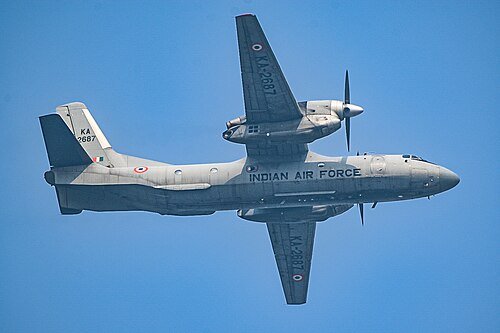
Pakistan issued an air-defence warning and diverted patrol aircraft after an Indian Air Force Antonov AN-32 transport aircraft approached the Pakistan border, according to reports.
The incident underscores the persistent tensions along the India-Pakistan border and the heightened alert posture maintained by Pakistan’s air defence network in response to IAF operations in frontier regions.
The Antonov AN-32 is a twin-engine transport aircraft that has served as a workhorse in the IAF’s logistics and operational transport fleet since the 1980s. The aircraft is capable of carrying 39 passengers or equivalent cargo loads and operates effectively from unprepared airfields, making it invaluable for remote border regions and high-altitude operations across India’s strategic zones.
The AN-32 has been instrumental in supporting military operations, disaster relief, and supply missions across challenging terrain. Its robust construction and proven reliability have made it a mainstay despite the IAF’s ongoing modernisation efforts, which include induction of newer platforms like the C-130J Hercules and the domestically developed C-295 transport aircraft.
Pakistan’s air defence system comprises Soviet-era radars integrated with more modern monitoring capabilities. The country maintains continuous surveillance along its eastern border, particularly in sectors where cross-border incidents have historically occurred. The diversion of patrol assets indicates that Pakistan’s command detected the AN-32’s proximity and activated standard protocols in response.
Such operational incidents are routine in the context of South Asian airspace management, where both nations maintain strict border protocols and rapid response mechanisms. The IAF regularly conducts transport operations, training missions, and logistics flights in border proximity areas, all of which are tracked by Pakistani air defence infrastructure.
The AN-32 incident reflects the continuing operational tempo along the India-Pakistan border. While the aircraft was performing a standard transport operation, Pakistan’s response demonstrates the sensitivity of cross-border airspace and the operational readiness of its defence establishment in response to perceived incursions or proximity breaches.
India’s Air Force maintains multiple AN-32s across various commands, with the fleet spread across eastern, western, and northeastern regions where border operations and remote logistics support remain critical functions. The aircraft’s presence in these zones is integral to India’s military preparedness and supply chain management in strategically important areas.
-
-

-
-