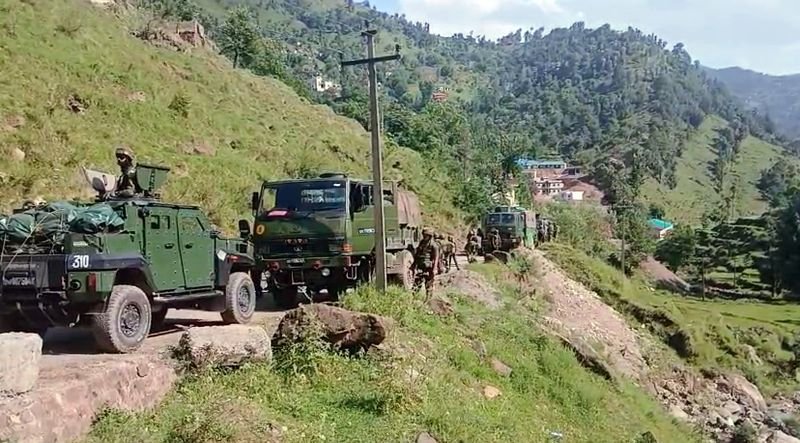
Operation Sheruwali, the ongoing counter-terror offensive in Rajouri district of Jammu and Kashmir, entered its eleventh day with intensified air support including helicopter and drone deployments, according to reports.
The operation, being conducted by the Indian Army in coordination with Jammu and Kashmir police and paramilitary forces, has shifted into a more technologically-enabled phase as ground forces continue to pursue militant networks in dense forested terrain along the Rajouri-Poonch sector.
Helicopter gunships have been mobilised to provide fire support and surveillance over the operational area, while unmanned aerial platforms enable real-time reconnaissance of suspected militant positions. This combination of manned and unmanned aviation assets reflects contemporary Indian military doctrine in counter-insurgency operations, where persistent ISR (intelligence, surveillance, reconnaissance) capability is critical to locating and engaging dispersed militant groups operating in mountainous terrain.
The Rajouri-Poonch region, spanning the Line of Control (LoC) in the Pir Panjal range, has historically been a transit corridor for cross-border militant infiltration. The rugged geography, dense forests, and limited road infrastructure make sustained ground operations challenging. Integration of air assets significantly multiplies the reach and effectiveness of infantry-based cordon-and-search operations by cutting off escape routes and providing real-time targeting intelligence.
The extended duration of Operation Sheruwali into double digits indicates either a large area of operations or sustained militant presence requiring systematic clearance. Extended counter-terror operations of this scale typically involve multiple infantry battalions, special forces teams, and support units coordinated under a single operational command. Helicopter support has become standard doctrine in such operations, offering rapid deployment capability, fire support, casualty evacuation, and resupply to forward positions.
Drone deployments in Indian Army counter-insurgency operations have evolved significantly over the past decade. These platforms provide commanders with persistent overhead surveillance, eliminating the need for risky ground patrols in certain situations. Modern tactical drones carry both electro-optical and infrared sensors, enabling operations during day and night, and can relay real-time video feeds to tactical operations centers and forward positions.
The Army’s reliance on helicopter and drone assets in high-altitude operations is complemented by improved intelligence coordination mechanisms established between Army formations, state police, and intelligence agencies. Cross-border militant groups operating in the Rajouri sector have demonstrated capability to conduct IED attacks and small-unit ambushes, making technological force-multiplication essential to minimizing casualty risks to Indian troops.
The continuation of Operation Sheruwali into the second week underscores the persistent security challenge in the Jammu frontier region despite improved border infrastructure and enhanced deployment patterns in recent years.
-
-

-

-