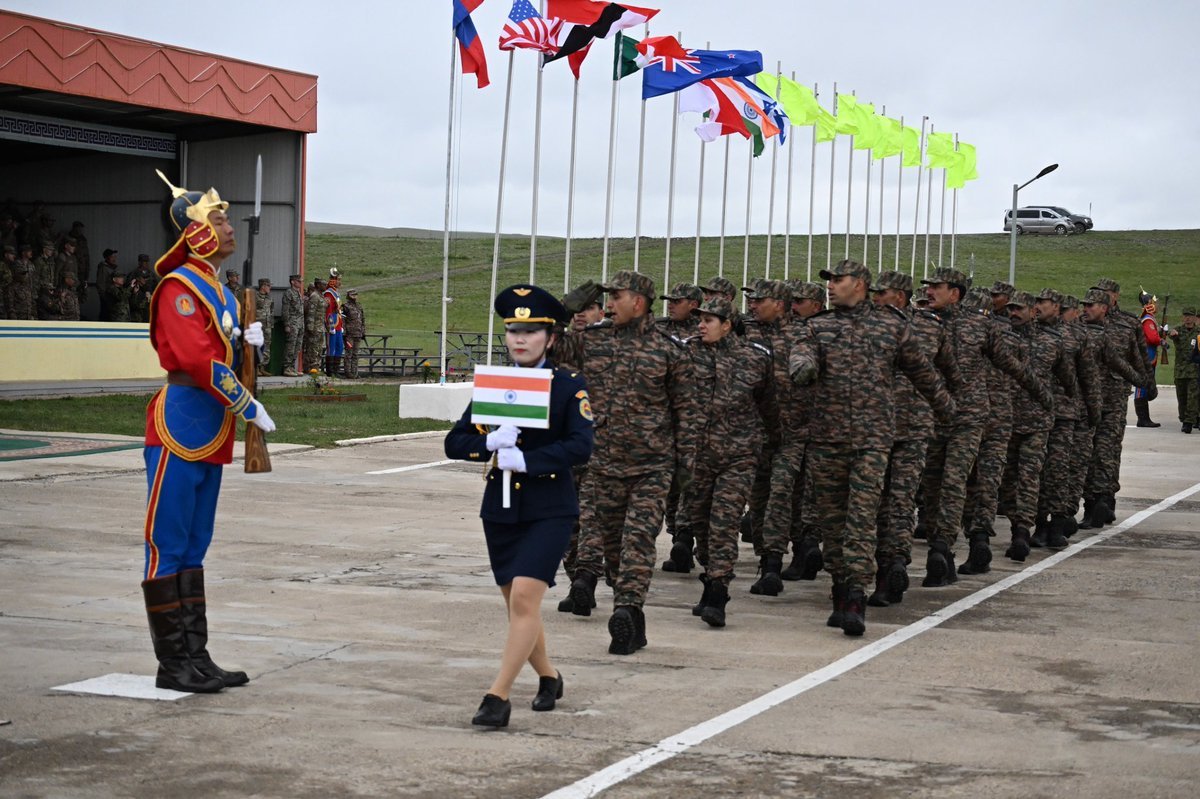
The Jat Regiment participated in a multinational joint exercise in Mongolia alongside soldiers from 18 countries, including the United States, according to reports.
The exercise represents India’s continued engagement in multilateral military training environments that build interoperability and tactical coordination among allied and partner forces across diverse operational contexts.
The Jat Regiment is one of the Indian Army’s oldest and most decorated infantry units, with a combat lineage spanning over a century and operational experience across multiple theatres including counterinsurgency operations in Jammu and Kashmir and high-altitude deployments along the Line of Actual Control.
Mongolia has emerged as a significant venue for multinational military exercises over the past decade. Its landlocked geography, open terrain, and neutral strategic positioning make it ideal for large-scale joint training involving forces from NATO members, Indo-Pacific partners, and Asian militaries.
India’s participation in such multinational exercises strengthens tactical doctrinal alignment with partner militaries, particularly on combined arms operations, command-and-control procedures, and logistics coordination. These interactions are increasingly central to India’s approach to building strategic relationships in the Indo-Pacific region.
The inclusion of US forces underscores the deepening military-to-military engagement between India and the United States under the framework of the Quad (Quadrilateral Security Dialogue) and bilateral defence cooperation mechanisms. Joint exercises at the unit and formation level have expanded significantly since the 2016 Logistics Exchange Memorandum of Agreement and the 2020 Basic Exchange and Cooperation Agreement.
The Jat Regiment’s deployment to a 18-nation exercise reflects the Indian Army’s commitment to building interoperability with forces across different doctrinal traditions and operational backgrounds, from NATO standardised procedures to regional military practices in Asia and the Pacific.
Such exercises generate valuable lessons in cross-border logistics, medical support, air-ground coordination, and rules of engagement interpretation, which are fed back into training curricula at the Infantry School in Mhow and corps-level combat training centres across India.
The exercise also signals India’s willingness to participate in global security architecture beyond traditional bilateral partnerships, positioning the Indian Army as a capable and professional participant in the emerging architecture of informal security coalitions in the Indo-Pacific and beyond.
-

-
-
-