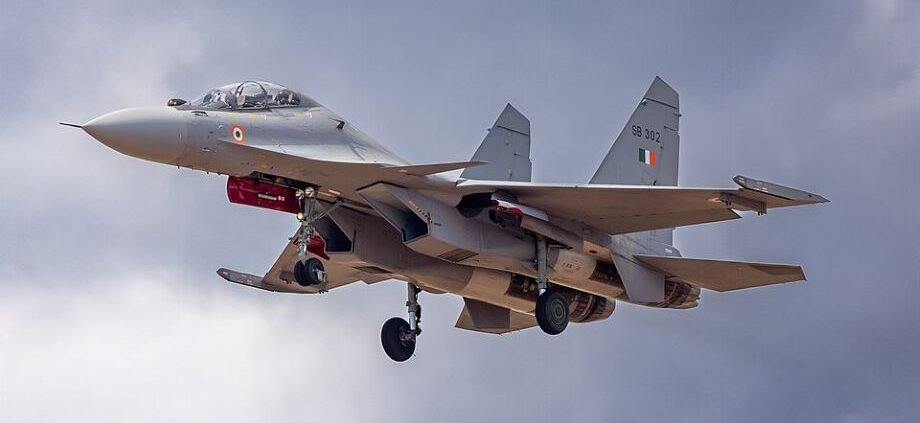
India is moving towards a significant technological upgrade of its frontline fighter fleet with the development of the indigenous Virupaksha Active Electronically Scanned Array (AESA) radar. Designed by the Defence Research and Development Organisation (DRDO), the advanced radar is expected to become one of the most important components of the Indian Air Force’s ambitious Super Sukhoi modernisation programme for its Su-30MKI fighter aircraft.
The new radar is being developed to replace the Russian-origin N011M Bars Passive Electronically Scanned Array (PESA) radar currently installed on the Su-30MKI. Its introduction is expected to improve the aircraft’s ability to detect, track and engage multiple aerial threats while operating in increasingly complex combat environments.
One of the most notable features of Virupaksha is its use of approximately 2,400 Gallium Nitride (GaN)-based transmit-receive modules. GaN technology offers advantages in power efficiency, heat management and signal performance compared with older radar technologies. These characteristics are expected to support improved detection capabilities, more effective target tracking and greater resistance to electronic interference.
Developed by DRDO’s Electronics and Radar Development Establishment (LRDE), Virupaksha builds on the technological experience gained through India’s Uttam AESA radar programme. However, the new system is being designed on a larger scale to meet the operational requirements of the twin-engine Su-30MKI, which has greater space and power requirements than lighter fighter aircraft.
The radar programme has progressed beyond its initial design stages. According to reports published in November 2026, the design architecture has been completed, while prototype fabrication and early testing activities are progressing. Initial power-on activities, commonly known as the first-light milestone, reportedly began in February 2026.
Before the radar can enter operational service, it must undergo extensive testing and validation. Planned activities include electromagnetic compatibility assessments and airborne evaluation of its subsystems. A modified Hawker-800 test aircraft is expected to support certain development trials, while testing on a Su-30MKI platform is anticipated as the programme advances. Full airborne testing using an Indian Air Force Su-30MKI is projected to begin around early 2028, subject to development progress.
The wider Super Sukhoi programme is intended to transform the Su-30MKI into a more capable 4.5-generation combat aircraft. Alongside the Virupaksha radar, the modernisation effort is expected to incorporate upgraded avionics, improved electronic warfare systems, enhanced cockpit displays and compatibility with advanced indigenous weapons.
The programme also represents an important opportunity for India’s domestic defence industry. DRDO is leading the radar’s development, while Indian industrial partners are contributing to the broader development and manufacturing ecosystem.
Once successfully tested, integrated and cleared for operational use, Virupaksha could significantly strengthen the Indian Air Force’s ability to conduct beyond-visual-range engagements, maintain situational awareness and operate in electronically contested airspace.
For India, the project is more than a radar replacement. It represents an important step towards developing advanced airborne sensors domestically and reducing dependence on foreign technology for critical combat aircraft systems. The success of Virupaksha will therefore play a major role in determining the future capabilities of the upgraded Su-30MKI fleet.
-

-

-
-