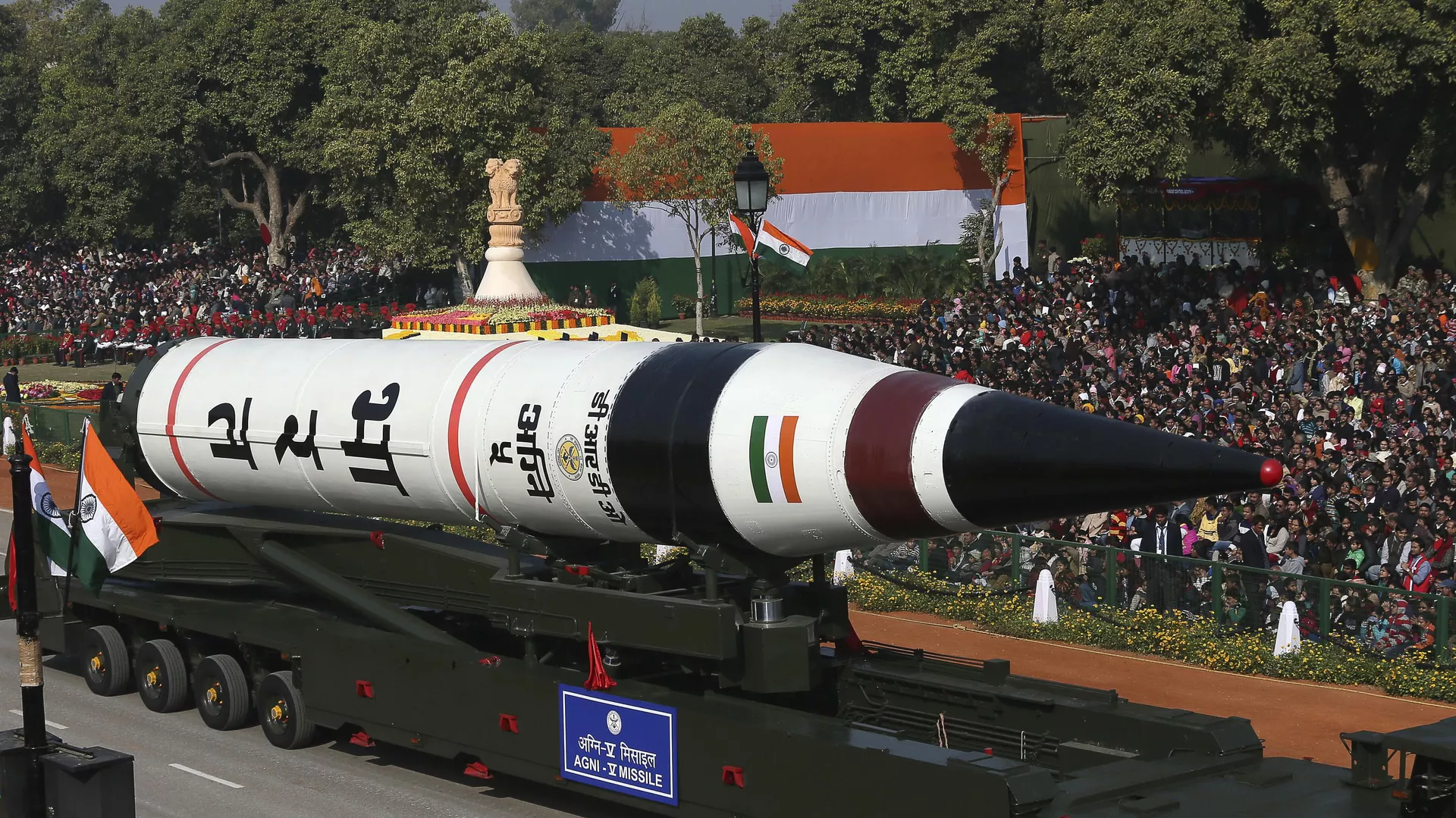
India’s nuclear warhead stockpile has expanded to approximately 190 warheads, according to the Stockholm International Peace Research Institute (SIPRI), further widening New Delhi’s strategic advantage over Pakistan in the subcontinental arms race.
SIPRI’s assessment places India among the world’s nine recognised nuclear-armed states, with a arsenal growth trajectory tied directly to the advancement of its ballistic missile delivery systems and fissile material production capacity at facilities operated by the Department of Atomic Energy.
India’s nuclear posture rests on a triad of delivery platforms: land-based ballistic missiles developed by DRDO, air-breathing systems integrated with the Indian Air Force, and submarine-launched ballistic missiles (SLBMs) deployed aboard the INS Arihant-class nuclear submarines operated by the Indian Navy. The Agni series of missiles, particularly the Agni-V with its 5,000-kilometre range, forms the backbone of India’s strategic deterrent against both China and Pakistan.
Pakistan’s estimated nuclear arsenal stands significantly smaller, reported at around 170 warheads by independent assessments. However, Pakistani military planners have invested heavily in tactical nuclear capabilities and shorter-range delivery systems, a strategic doctrine that differs markedly from India’s emphasis on intercontinental strike range and survivability through submarine-based systems.
India maintains an official posture of nuclear ambiguity regarding the exact size and composition of its arsenal, a principle established since the 1998 Pokhran-II tests. The government neither confirms nor denies specific warhead counts, though SIPRI and international strategic institutes conduct open-source analysis based on fissile material production estimates, missile test data, and defence procurement patterns.
The expansion reflects India’s long-term commitment to credible minimum deterrence, a doctrine that emphasises survivable second-strike capability rather than numerical parity with larger nuclear powers. DRDO continues development of advanced variants, including hypersonic delivery vehicles and MIRV-capable missiles, to maintain technological edge over the coming decade.
India has consistently advocated for nuclear disarmament at international forums while simultaneously modernising its own deterrent. The country is not a signatory to the Non-Proliferation Treaty (NPT) as a non-nuclear weapons state, having declared its status after the 1998 tests, and maintains that its nuclear programme serves strictly defensive purposes under civilian control through the Atomic Energy Commission.
Strategic analysts note that India’s warhead increase aligns with broader defence modernisation priorities, including expansion of naval capabilities and development of hypersonic cruise missiles. The integration of nuclear systems with conventional strike capabilities, demonstrated through exercises like Gagan Shakti, underscores the military’s multi-spectrum operational planning in the Indo-Pacific region.
-

-
-

-