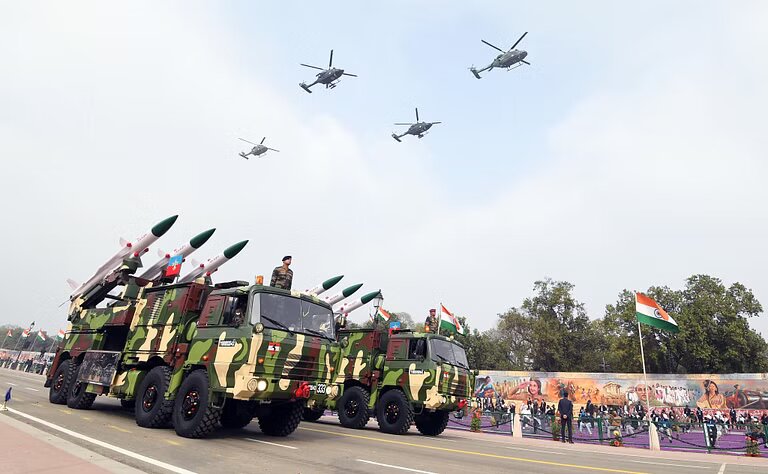
The Indian Army is actively pursuing a tracked platform to equip its air defence units, signalling a modernisation push to enhance mobility and firepower in air defence operations across diverse terrain.
According to Asian Military Review, the Army’s requirement reflects a strategic shift toward self-propelled, tracked air defence systems that can manoeuvre alongside armoured formations and keep pace with mechanised infantry units in high-intensity conflict scenarios.
India’s air defence architecture has traditionally relied on a mix of towed systems such as the Tunguska and radar-guided platforms. A tracked air defence vehicle would represent a generational upgrade, combining radar search-and-track capability, rapid-fire cannon armament, and short-range surface-to-air missile integration on a highly mobile chassis.
The Indian defence ecosystem has demonstrated capability in this domain. DRDO’s Akash air defence system, while primarily road-mobile, has proven its network-centric warfare credentials in multiple exercises. The addition of a tracked platform would complement Akash and provide lower-tier air defence closer to forward positions where dismounted air defence cannot operate effectively.
The Army’s focus on tracked mobility aligns with its broader mechanisation roadmap, which prioritises platforms capable of operating in high-altitude, snow-bound, and riverine terrain along India’s northern and northeastern frontiers. A tracked air defence system would enhance the Army’s ability to provide organic air cover to mechanised columns in these challenging environments.
India has studied global precedents, including systems such as the Gepard (Germany), Tunguska (Russia), and Skyranger (Germany). However, indigenous development through DRDO or public-private partnerships remains the preferred pathway aligned with the Make in India defence strategy and the broader push for self-reliance in critical platforms.
The requirement is likely to be fulfilled either through technology transfer agreements with established defence contractors or through accelerated DRDO development programmes that leverage existing subsystems such as search-and-track radars, air defence missile seekers, and automotive platforms already in service with the Army.
This procurement initiative underscores India’s recognition that modern air defence must be fully integrated with ground manoeuvre elements, capable of autonomous operation, and equipped to counter emerging air threats including tactical drones and low-altitude cruise missiles.
-

-

-
-