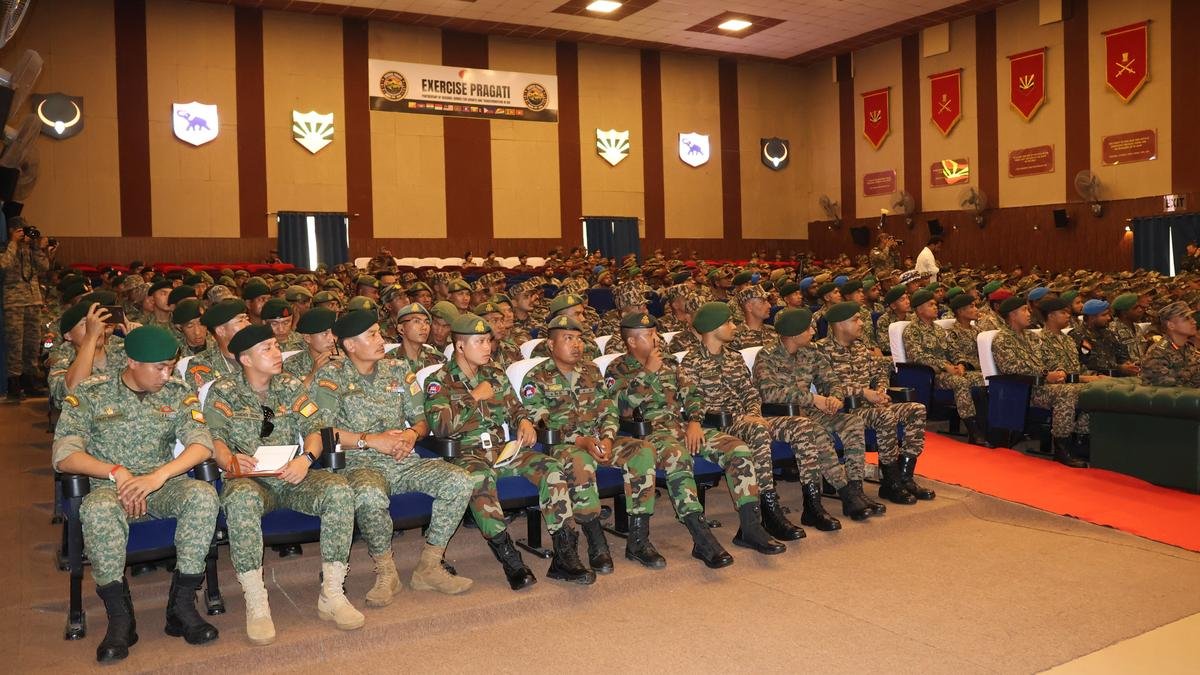
The Indian Army showcased both traditional and robotic canine units at PRAGATI 2026, highlighting the military’s evolving approach to force modernization and operational capability, according to reports from the exercise.
PRAGATI, the biennial joint services exercise hosted by the Indian Army, serves as a critical platform for testing integrated warfare concepts, inter-service coordination, and emerging technologies. The 2026 iteration brought together combat units, support formations, and specialized wings to validate tactical doctrine in complex, multi-domain scenarios reflective of contemporary security challenges.
The integration of robotic canine systems alongside traditional K9 units underscores the Indian Army’s commitment to technological augmentation of frontline capabilities. While operational canines have served as core assets in border patrol, search and rescue, and mine detection roles for decades, robotic variants introduce advantages in high-risk environments: they eliminate handler casualties in mine-clearance operations, can operate in chemical, biological, or contaminated zones, and provide reconnaissance in confined spaces where live animals face physiological constraints.
India’s defence establishment, particularly the Defence Research and Development Organisation (DRDO), has been pursuing indigenous development of robotics platforms tailored to military requirements. Robotic dogs represent one segment of a broader push toward autonomous systems capable of surveillance, logistics support, and threat detection in forward areas. These platforms align with India’s Make in India initiative, reducing dependence on foreign acquisition for specialized military hardware.
Traditional K9 units remain indispensable across the Indian military. Breeds such as Labrador Retrievers, German Shepherds, and specialized strains developed by military breeding programmes like the Army’s own canine centers at Bangalore and Meerut continue to excel in roles requiring adaptive intelligence, scent detection, and rapid decision-making under stress. Their endurance, trainability, and operational resilience in challenging terrain, from the Himalayan heights to desert borderlands, make them irreplaceable assets.
The dual presentation of biological and robotic K9 warriors at PRAGATI 2026 reflects a mature understanding that technological modernization need not displace proven capabilities. Rather, hybrid approaches that leverage both are increasingly the norm in professional militaries worldwide. The Indian Army’s demonstration signals confidence in pursuing this balanced trajectory as force structures adapt to 21st-century operational demands.
-
-

-

-