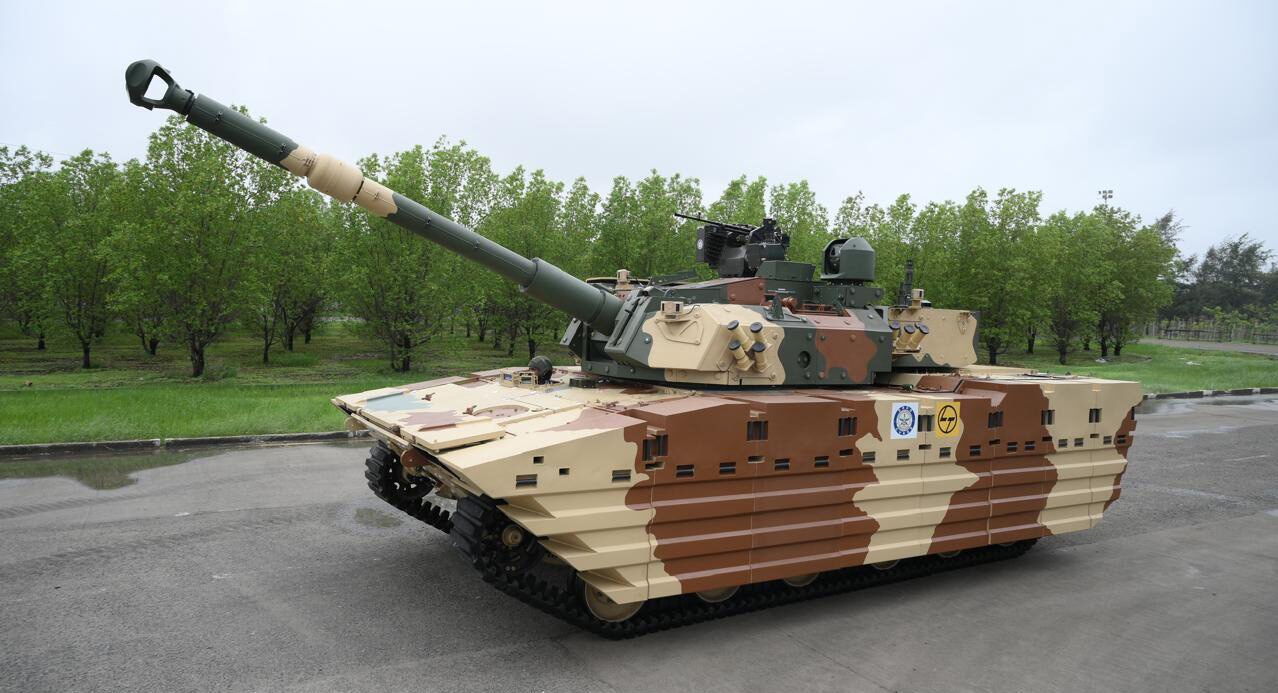
The Indian Army is pursuing upgrades to the Zorawar light tank’s protective capability without compromising its strategic mobility advantage, a critical design balance for high-altitude operations in Ladakh and the Eastern Sector.
Zorawar, jointly developed by DRDO and industry partners, is a 35-tonne platform designed to operate across India’s mountain terrain where heavier main battle tanks face severe logistical constraints. The vehicle entered service trials in 2023 and is earmarked to equip mechanised mountain divisions and rapid reaction formations operating above 3,000 metres.
The armour enhancement initiative reflects operational lessons from deployment patterns and evolving threat assessments in high-altitude zones. Adding protective capability to a light tank requires precise trade-offs: increased armour weight reduces payload capacity and fuel range, while lighter composite solutions offer less stopping power against modern kinetic and shaped-charge threats.
Zorawar’s baseline design incorporates modular armour panels that allow operators to scale protection levels based on threat environment. The vehicle’s 105mm rifled gun and compact turret are optimised for mountain warfare, where traditional heavy armour becomes a liability rather than advantage. The tank’s 550 horsepower engine was selected to maintain cross-country performance even with modular upgrades installed.
This armour initiative aligns with India’s broader indigenisation strategy for armoured vehicles. The Army operates T-72 and T-90 main battle tanks in the plains, but their 46-50 tonne weight makes deployment to high-altitude terrain prohibitively expensive in terms of logistics and infrastructure modification. Zorawar fills this operational gap by delivering fire support and anti-tank capability at altitudes where traditional armour cannot operate effectively.
The light tank project reflects India’s focus on asymmetric operational requirements along contested borders. China’s People’s Liberation Army has invested heavily in light tracked vehicles for its Tibet and Xinjiang commands, making indigenous Indian alternatives strategically essential. Zorawar’s development reduces dependence on foreign platforms and enables rapid customisation for Indian battlefield conditions.
Production timelines for Zorawar have accelerated since initial trials began. The upgraded variant with enhanced armour is expected to undergo validation testing before full-rate production orders are placed. The Army has projected requirements for several hundred units across multiple mechanised divisions.
Protection enhancement comes as the Army continues evaluating lightweight composite materials developed by DRDO’s Materials Science Division. Steel-based modular armour remains the primary near-term solution, but advanced composites offer weight advantages for future variants. Any armour upgrade must maintain Zorawar’s amphibious crossing capability, a key requirement for operations across Himalayan river systems.
-

-
-
-