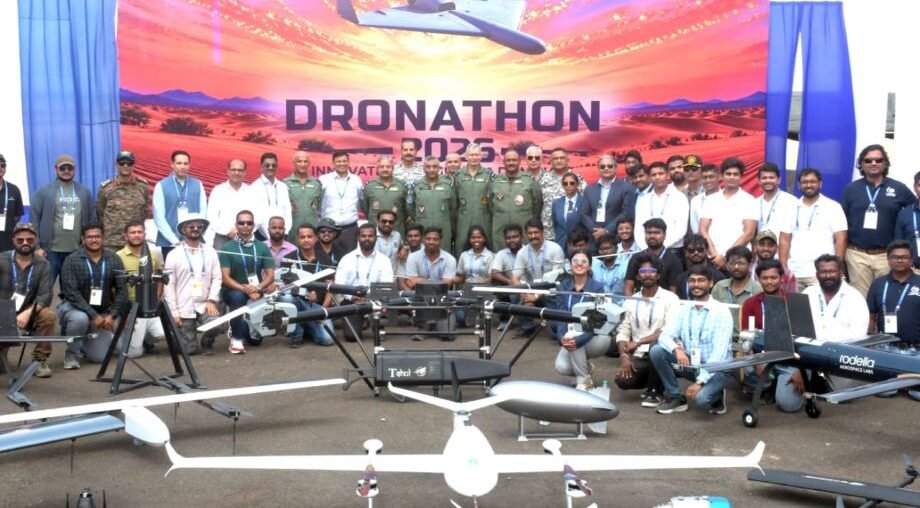
The Indian Air Force has showcased Vayu UTtaM, an indigenous multi-mode Unmanned Traffic Management system, during Dronathon-2026 at the Pokhran Field Firing Range in Jaisalmer, Rajasthan. The demonstration forms part of the IAF’s effort to examine emerging unmanned technologies and their potential use in increasingly complex airspace environments.
Held from September 14 to 16, 2026, Dronathon-2026 has provided an operational setting for Indian defence companies, start-ups, MSMEs, DPSUs and technology developers to demonstrate their unmanned systems. The event is focused on evaluating technologies that can meet future requirements in both unmanned operations and counter-unmanned warfare.
At Pokhran, Vayu UTtaM was demonstrated in a live environment where it detected and tracked military and civilian unmanned aircraft systems. The capability is intended to provide a structured way of monitoring unmanned aircraft activity and supporting the coordination of drone operations when multiple systems are operating within the same airspace.
The system is also designed to assist with the identification and timely mitigation of unauthorised or rogue drones. This capability is becoming increasingly relevant as unmanned aircraft are being adopted for a wider range of military, commercial and civilian purposes.
The Ministry of Defence has indicated that the potential utility of Vayu UTtaM extends beyond defence applications. The technology can support areas such as airspace safety, civil aviation, critical infrastructure and public safety, where the ability to monitor unmanned aircraft can contribute to safer operations.
Dronathon-2026 has brought together more than 20 participants from India’s unmanned systems ecosystem, including defence firms, start-ups, MSMEs, DPSUs and innovators. Their demonstrations cover technologies associated with surveillance and reconnaissance, autonomous operations, swarm systems, electronic warfare and Counter-Unmanned Aircraft Systems.
The IAF is using the event not simply to view new drone technologies but to examine how these systems perform in demanding and operationally relevant conditions. Such evaluations can provide insights into the reliability, adaptability and effectiveness of emerging indigenous solutions.
A major development at the event was the release of the IAF UAS Roadmap by Vice Chief of the Air Staff Air Marshal Ashutosh Dixit. The roadmap is intended to give industry, academia and research organisations a clearer understanding of the Air Force’s future priorities in the unmanned aircraft systems sector.
The roadmap also points towards a wider technology ecosystem rather than focusing only on complete drone platforms. Areas such as propulsion, sensors, payloads, communications, autonomy, electronic warfare, countermeasures and airspace management are becoming increasingly important to the development of future unmanned capabilities.
The Vayu UTtaM demonstration therefore represents part of the IAF’s broader engagement with India’s indigenous unmanned technology sector. By testing such capabilities in a field environment at Pokhran, Dronathon-2026 is providing an opportunity to examine technologies that could support the management of increasingly active unmanned-aircraft operations in the future.
-

-

-

-