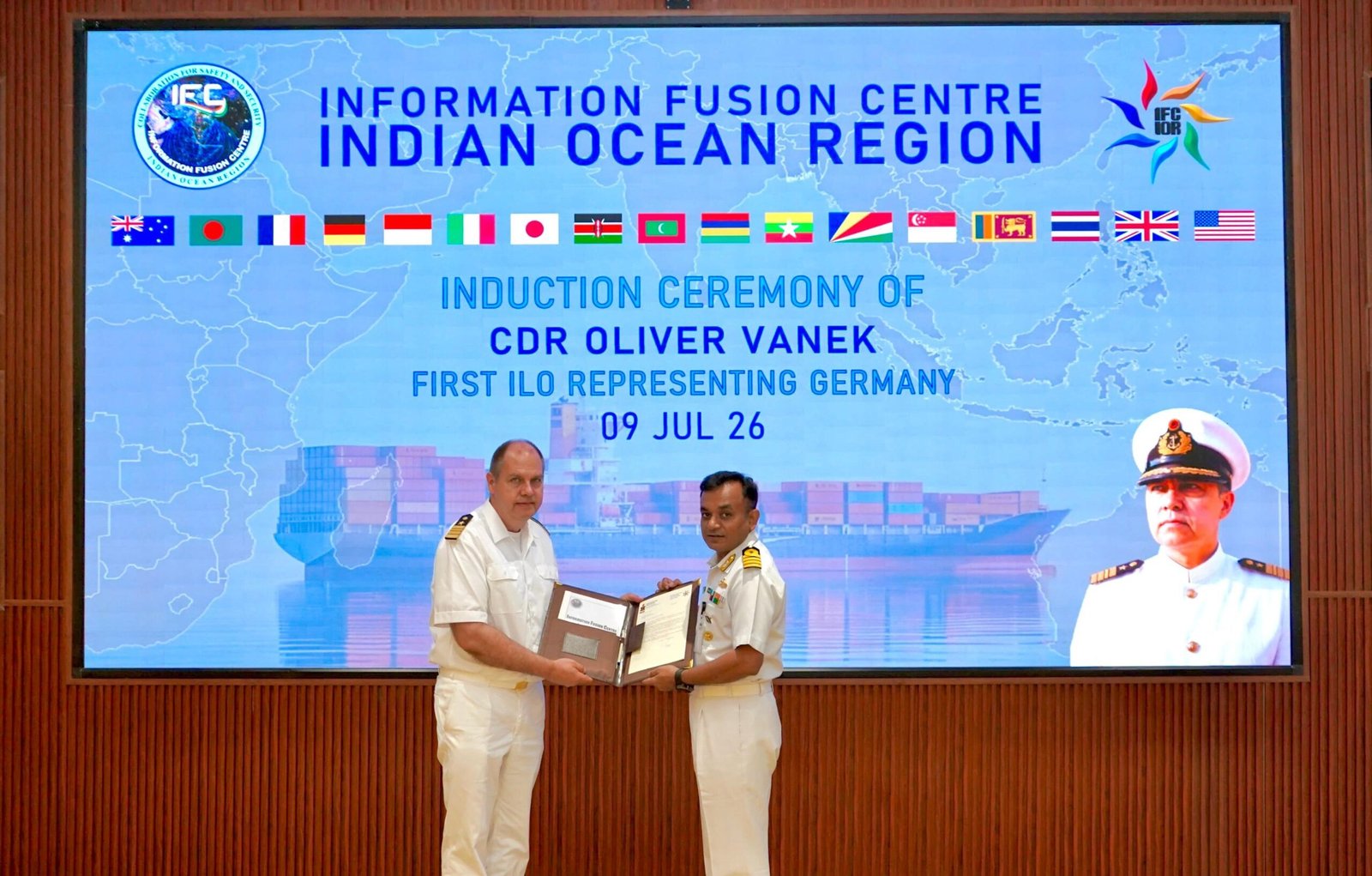
Germany and Indonesia have posted their first liaison officers at India’s Indian Ocean Region Information Fusion Centre (IFC-IOR) in Gurugram, marking a significant expansion of the maritime intelligence hub’s international operational footprint.
The IFC-IOR, established by the Indian Navy in 2015, serves as a multinational centre for maritime domain awareness across the Indian Ocean. It collates vessel movement data, environmental information, and maritime intelligence from participating nations to enable coordinated responses to security threats, piracy, and environmental hazards in one of the world’s most strategically vital waterways.
The stationing of permanent liaison officers from Germany and Indonesia reflects growing confidence in the centre’s analytical capabilities and underscores India’s role as a convenor of maritime security architecture in the Indo-Pacific. Both nations have substantial maritime interests: Indonesia commands critical chokepoints in Southeast Asia, while Germany maintains naval operations in the region as part of its Indo-Pacific engagement strategy.
The IFC-IOR operates through a nodal hub in Gurugram connected to information-sharing partnerships with over 20 nations including France, Japan, Australia, Sri Lanka, Mauritius, and others. Liaison officers from partner nations work alongside Indian Navy personnel and civilian analysts to integrate real-time vessel tracking, weather systems, and intelligence inputs into a unified operational picture.
India’s maritime domain awareness architecture has expanded considerably since the centre’s inception. The Navy operates multiple Dornier maritime patrol aircraft, P-8I Neptune long-range surveillance platforms, and satellite-based ocean observation systems that feed into IFC-IOR assessments. This multi-source intelligence foundation has made the centre a credible partner for nations seeking improved visibility over Indian Ocean traffic.
The addition of German and Indonesian liaison officers occurs against a backdrop of renewed geopolitical competition in the Indo-Pacific. Both nations have elevated their naval presence and regional engagement in recent years. Indonesia, as the world’s largest archipelago, faces persistent maritime security challenges including illegal fishing and transnational crime. Germany has committed to regular naval deployments to demonstrate its commitment to free and open navigation.
India’s IFC-IOR also complements bilateral maritime security arrangements and multilateral mechanisms such as the Indian Ocean Rim Association (IORA) and the Quad framework. The presence of foreign liaison officers enhances the centre’s ability to provide actionable intelligence to regional partners and strengthens interoperability during coordinated maritime operations or crisis response scenarios.
-

-

-

-