France has equipped its Rafale fighter aircraft with low-cost rocket systems designed to counter unmanned aerial vehicle threats similar to those posed by Iranian-origin Shahed drones.
The move reflects a growing operational shift across NATO and allied air forces to develop cost-effective counter-drone capabilities. Traditional air-to-air missiles carry unit costs in the millions, making them economically impractical against swarms of cheaper unmanned systems.
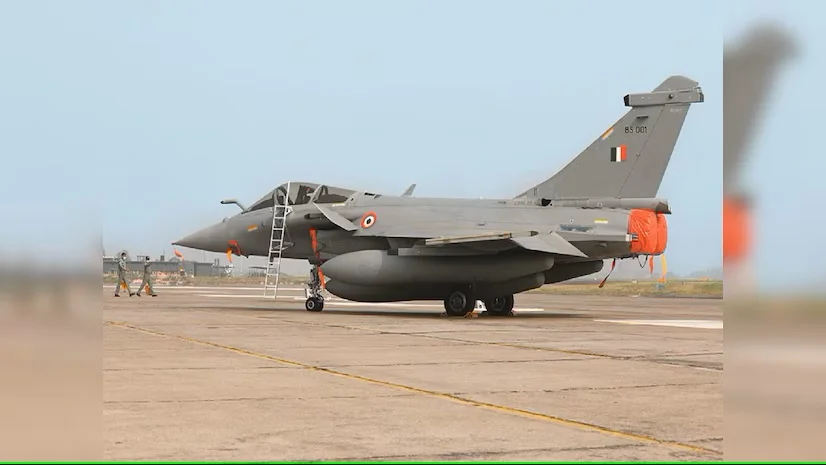
The Rafale, a fourth-generation multirole fighter, has been in service with the Indian Air Force since 2020. India received its first batch of 36 aircraft under a government-to-government agreement with France, with deliveries completed by 2023. The platform has demonstrated operational effectiveness across air-to-air, air-to-ground, and air-to-sea missions, and carries a diverse payload of guided and unguided munitions.
India’s Air Force has been tracking international developments in counter-unmanned systems capability. The proliferation of armed drones across South Asia and the Middle East has prompted air arms globally to experiment with supplementary weapons that offer lower per-shot costs than standoff guided missiles.
The Rafale’s integration flexibility allows it to carry an expanding range of armaments alongside its standard Meteor beyond-visual-range air-to-air missile suite and SCALP cruise missiles. The addition of low-cost rocket or unguided munition options under operational doctrine represents a tactical evolution rather than a fundamental redesign.
France’s Defence Procurement Agency and Dassault Aviation have consistently enhanced the Rafale’s mission capability through incremental upgrades and payload integration. The aircraft’s modular avionics architecture and open systems approach enable rapid adoption of new weapons without extensive re-certification cycles.
For the Indian Air Force, operational lessons from France’s counter-drone experiments carry direct relevance. The service has integrated Rafale squadrons into forward-positioned bases across northern and northeastern operational zones, where persistent surveillance and rapid response to airspace intrusions remain priority tasks.
Pakistan’s demonstrated use of armed unmanned systems and increasing drone activity across South Asia have sharpened focus on layered air defence. While India’s dedicated air defence radar and ground-based missile systems provide strategic coverage, tactical fighter-based counter-drone measures offer flexibility in contested airspace.
The Rafale’s sensor fusion capability, integrating real-time data from ground radars and airborne platforms, positions it effectively in a multi-layered counter-UAS posture. France’s integration of low-cost munitions into this operational envelope suggests that advanced fighters remain relevant platforms for evolved threats, rather than requiring entirely new purpose-built systems.
-

-

-

-