The Defence Research and Development Organisation (DRDO) has achieved another milestone in India’s indigenous defence technology programme with the successful high-altitude trial of its Military Combat Parachute System (MCPS) in Ladakh.
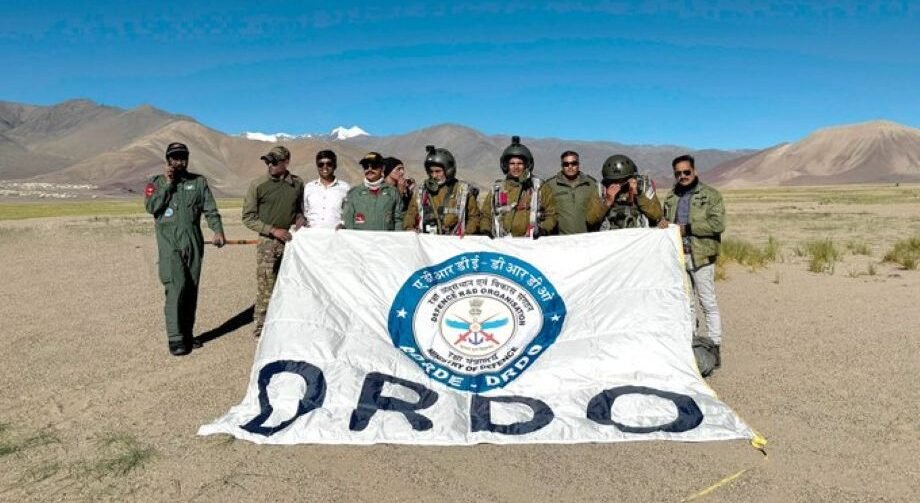
The trial was conducted at the Nyoma-Mudh drop zone, where DRDO test jumpers carried out a parachute descent after exiting an aircraft at 22,000 feet above mean sea level. The exercise was conducted in temperatures of around minus 15 degrees Celsius, exposing the system to the demanding conditions associated with high-altitude operations.
The test was undertaken by personnel from DRDO’s Aerial Delivery Research and Development Establishment (ADRDE), Agra. Wing Commander Rahul Jha, Chief Test Jumper, along with Master Warrant Officers R J Singh and Vivek Tiwari, participated in the trial.
During the operation, the test team used the indigenous MCPS together with supporting systems developed for such missions, including an indigenous para computer, oxygen system and specialised jumpsuits. The parachute was opened at approximately 20,000 feet, and the jumpers subsequently completed a safe landing at around 13,700 feet.
The latest demonstration was aimed at establishing how effectively the parachute system performs when operating at extreme altitude. Such environments place additional demands on airborne equipment because of low temperatures, reduced oxygen availability and challenging atmospheric conditions.
The MCPS has been developed as an indigenous solution for military parachute operations. Its design provides controlled descent and steering capabilities, allowing personnel to manage their movement after parachute deployment and approach a designated landing area.
The system has also been developed for specialised high-altitude insertion missions. Its earlier testing included a combat freefall from 32,000 feet, demonstrating the system’s ability to support operations at very high altitudes. According to DRDO, the MCPS is currently the only parachute system in operational use by the Indian Armed Forces capable of deployment above 25,000 feet.
The MCPS programme involves DRDO’s ADRDE and the Defence Bioengineering and Electromedical Laboratory (DEBEL), Bengaluru. The development of the system and its associated equipment forms part of India’s wider effort to build critical military technologies domestically.
For airborne and specialised military units, the ability to conduct parachute operations in high-altitude areas can provide an additional method of rapidly deploying personnel into difficult terrain. An indigenous system can also strengthen domestic control over maintenance, upgrades and long-term operational support.
The successful Ladakh trial therefore goes beyond a routine parachute test. By conducting the demonstration at 22,000 feet and in sub-zero conditions, DRDO has subjected the MCPS to an environment that closely reflects the challenges faced by military personnel operating in the Himalayan region.
DRDO said the trial demonstrated the efficacy, reliability and tactical employability of the MCPS under extreme high-altitude conditions. The achievement further supports India’s objective of reducing dependence on foreign sources for critical defence equipment and strengthening indigenous capabilities for specialised military operations.
The successful test at Nyoma-Mudh adds another achievement to India’s growing portfolio of indigenous aerial delivery technologies and demonstrates DRDO’s continued focus on developing systems capable of performing in some of the country’s most challenging operational environments.
-
-
-

-