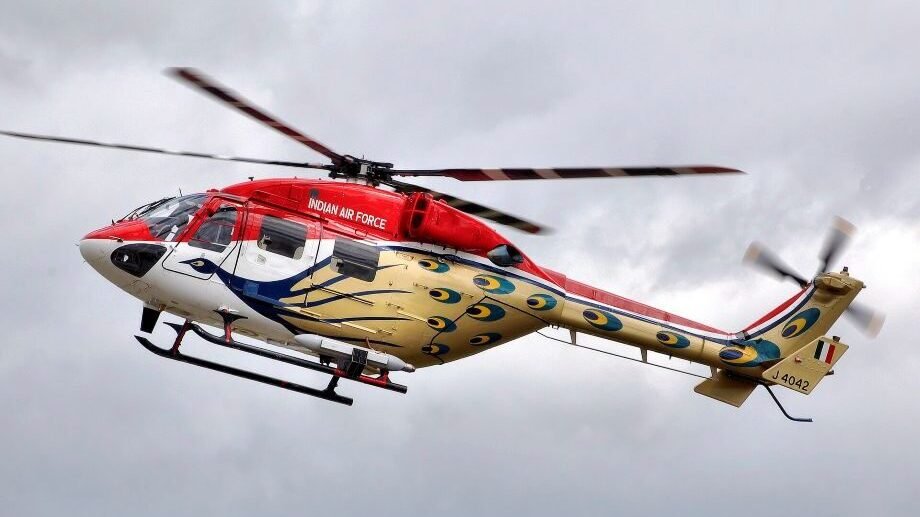
India’s indigenous defence technology capabilities continue to strengthen with the development of advanced ceramic-faced composite armour for the Army variant of the Advanced Light Helicopter (ALH) Dhruv. Developed by the Defence Research and Development Organisation (DRDO), the protective system is designed to improve helicopter survivability by shielding aircrew and critical sections of the aircraft against heavy ground-based firing threats.
The technology has been developed by DRDO’s Defence Materials and Stores Research and Development Establishment (DMSRDE). It addresses one of the major challenges in military aviation: providing effective ballistic protection without adding excessive weight to an aircraft. For helicopters operating in demanding environments, additional weight can affect payload capacity, manoeuvrability and overall flight performance. The composite armour offers a lighter alternative to conventional steel-based protection while maintaining the required ballistic resistance.
According to DRDO’s technical documentation, the armour panels are designed to protect against 12.7 mm armour-piercing incendiary (API) ammunition. The system uses a dual-layer construction combining a hard ceramic striking surface with aramid and epoxy composite laminates as the backing material. This arrangement allows the armour to manage projectile impact through two complementary stages.
When a projectile strikes the ceramic surface, the hard outer layer helps damage and break down its penetrating structure. The composite backing then absorbs the remaining impact energy and helps stop fragmented projectile material from penetrating further. This combination improves protection while keeping the overall armour weight lower than comparable monolithic steel armour solutions.
Before receiving clearance, the protective panels underwent several technical evaluations to establish their suitability for military aviation. These included strength assessments, environmental testing, shock and vibration tests, immersion evaluations, flame resistance checks, temperature stability examinations and ballistic testing. Such evaluations are essential to ensure that protective equipment can withstand operational conditions without compromising aircraft safety.
DRDO’s published technical document confirms that the armour panels were installed on the Army version of the ALH. Carriage and flight trials were also conducted, with satisfactory results. The system subsequently received provisional clearance from the Regional Centre for Military Airworthiness (RCMA), Helicopter, followed by clearance from the Centre for Military Airworthiness and Certification (CEMILAC) for bulk production.
The development is significant for India’s military aviation fleet because helicopters frequently operate at relatively low altitudes during troop transportation, reconnaissance and other operational assignments. At these altitudes, aircraft can face threats from ground-based weapons, making additional protection for personnel and critical aircraft sections an important operational requirement.
The project also demonstrates the importance of indigenous materials research in strengthening India’s defence manufacturing ecosystem. Developing specialised protective materials domestically can reduce dependence on imported technologies and provide Indian defence manufacturers with greater opportunities to support military aviation requirements.
As the Indian armed forces continue to modernise their equipment, technologies that balance protection, weight and operational performance will remain important. DRDO’s ceramic-faced composite armour represents a significant contribution to improving the survivability of the ALH Dhruv and strengthening India’s capabilities in indigenous aerospace protection systems.