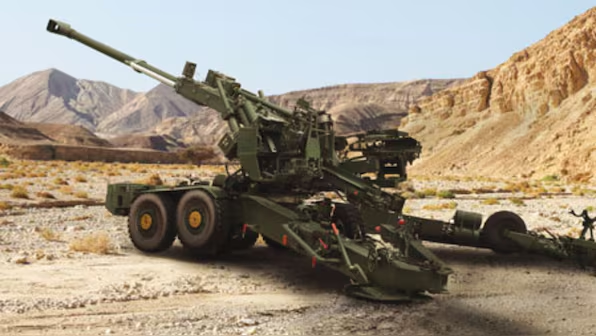
Armenia has signed a $2 billion defence contract with India to acquire advanced weapon systems, officials said, marking a significant expansion of military cooperation between New Delhi and Yerevan as Armenia seeks to bolster its defensive capabilities against regional adversaries including Azerbaijan, Pakistan, and Türkiye.
The procurement represents India’s growing role as a defence supplier to non-aligned nations in strategically sensitive regions. Armenia, a South Caucasus nation, has faced repeated military pressure from Azerbaijan, which maintains close defence ties with both Türkiye and Pakistan. The timing of the Indian purchase underscores Armenia’s effort to diversify its defence partnerships beyond its traditional Russian supplier.
India has emerged as a major arms exporter over the past decade, particularly in platforms suited to regional air defence, surveillance, and precision strike roles. The Armenian deal reflects New Delhi’s strategic interest in strengthening partnerships with nations facing pressure from Pakistan-aligned actors. India has long positioned itself as a preferred defence partner for countries seeking non-aligned but capable military hardware.
The Indian defence sector, including DRDO and private manufacturers, has scaled production of multiple platforms suitable for smaller air forces and ground forces requiring rapid deployment capability. Systems in India’s current export portfolio include air defence radars, loitering munitions, artillery fire control systems, and lightweight air defence guns. Armenia’s requirement profile typically emphasises counter-drone capabilities and tactical air defence given Azerbaijan’s demonstrated use of unmanned systems in previous clashes.
The $2 billion value suggests a comprehensive package combining sensors, command systems, and effectors rather than single-platform acquisition. Such integrated deals allow India to offer end-to-end solutions that are cost-effective compared to Western equivalents while avoiding geopolitical restrictions on advanced technology transfer.
Armenia’s defence modernisation also reflects lessons learned from the 2020 Nagorno-Karabakh conflict and subsequent border clashes with Azerbaijan. Indian suppliers have proven responsive to post-conflict requirement changes, allowing rapid integration of operational feedback into system design and deployment.
This deal positions India as a counter to the Azerbaijan-Türkiye-Pakistan defence nexus in the South Caucasus and reinforces New Delhi’s broader strategy of supporting nations aligned with Indian strategic interests across Eurasia and the Middle East. The contract also demonstrates India’s capacity to compete against Russian, European, and Israeli suppliers in complex regional markets.
-

-

-

-