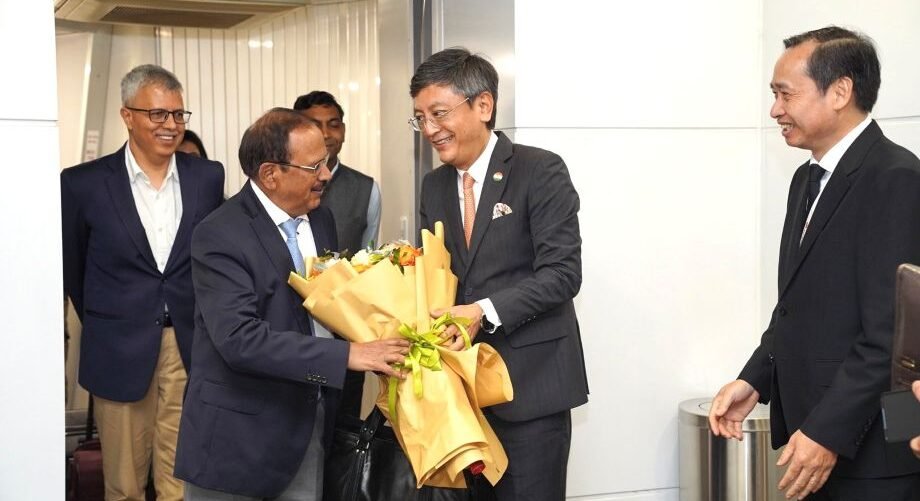
India’s National Security Adviser Ajit Doval arrived in Vietnam’s capital, Hanoi, on November 1 for an official visit aimed at advancing cooperation between the two countries. His arrival marks another significant high-level diplomatic engagement as India and Vietnam work to strengthen their expanding strategic relationship.
According to the Indian Embassy in Vietnam, Doval will interact with Vietnamese leadership during the visit in line with the India-Vietnam Enhanced Comprehensive Strategic Partnership. The engagement is expected to provide an opportunity for both sides to review their existing cooperation and identify further areas of mutual interest.
Defence and national security are important components of the relationship between New Delhi and Hanoi. Over the years, India and Vietnam have expanded their military engagement through defence dialogues, training programmes, naval cooperation and exchanges between their armed forces. Both countries have also expressed interest in strengthening defence industry collaboration and exploring opportunities involving military technology and equipment.
The visit follows the fourth India-Vietnam Security Dialogue, conducted in New Delhi in October 2026. During the meeting, officials from both countries discussed several important security-related subjects, including counter-terrorism, maritime security, cybersecurity, economic security and emerging technologies. The discussions reflected their shared interest in addressing evolving regional and international security challenges.
Maritime cooperation remains particularly important to both countries because of their interests in maintaining peace and stability across the Indo-Pacific region. India and Vietnam support respect for international law and freedom of navigation, while seeking stronger coordination on maritime security and regional stability.
The defence relationship also has a long-term framework through the Joint Vision Statement on India-Vietnam Defence Partnership towards 2030. The agreement provides direction for expanding military cooperation, capacity building, defence technology engagement and industrial partnerships. India’s previous defence assistance to Vietnam, including the transfer of INS Kirpan in 2023, demonstrates the practical dimension of this growing relationship.
Bilateral relations received another major boost in May 2026 when Vietnamese President To Lam visited India. During the visit, both countries elevated their relationship to an Enhanced Comprehensive Strategic Partnership, creating a stronger framework for cooperation in defence, trade, technology and other strategic sectors. The two governments also set an ambitious target of achieving USD 25 billion in bilateral trade by 2030.
Beyond traditional defence engagement, India and Vietnam are increasingly exploring cooperation in artificial intelligence, digital transformation, cybersecurity and other advanced technologies. These areas are becoming important to their broader strategic relationship as both countries seek to improve technological capabilities and strengthen economic resilience.
Vietnam is an important partner in India’s Act East Policy and its wider Indo-Pacific engagement. Stronger relations with Hanoi also provide opportunities for India to deepen its partnerships across Southeast Asia.
Doval’s arrival in Hanoi therefore highlights the importance both countries attach to continued high-level dialogue. His discussions with Vietnamese leaders are expected to support ongoing strategic initiatives and maintain momentum in the India-Vietnam partnership, particularly in defence, security and regional cooperation.
-
-
-
-