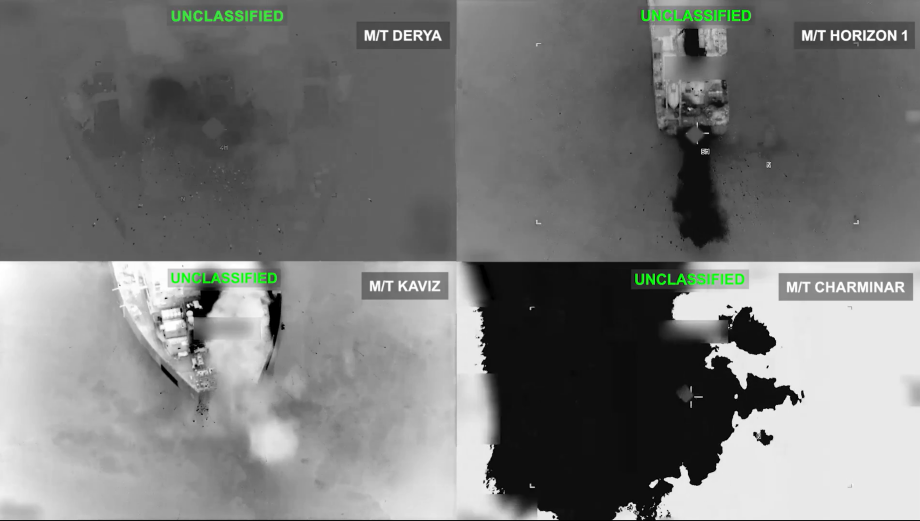
The United States has launched strikes against five Iranian oil carriers in a major escalation of military tensions with Tehran, after the Islamic Revolutionary Guard Corps (IRGC) allegedly attempted to attack an American warship with ballistic missiles. The operation targeted Iranian crude carriers operating in waters around the Gulf of Oman and near Iran’s strategically important Kharg Island.
U.S. Central Command said the American warship came under two separate attempted missile attacks over a two-day period. According to the U.S. military, the vessel managed to evade the incoming threats and there were no reported injuriesUS Strikes Iranian Oil Carriers After Missile Threat to American Warship among its crew. Washington subsequently authorized strikes against five Iranian crude-oil carriers that it said were connected to Iran’s IRGC.
The vessels targeted during the operation included M/T Kaviz, M/T Charminar, M/T Horizon 1 and M/T Riesco in the Gulf of Oman, while M/T Derya was struck in the vicinity of Kharg Island. U.S. forces said personnel aboard the vessels were instructed to leave before the attacks were carried out, after which the ships were struck and disabled.
The operation has particular significance because of the location of the attacks. Kharg Island is a central hub for Iran’s crude-oil exports, while the Gulf of Oman provides an important maritime route linking the Persian Gulf with the wider Indian Ocean. Military activity in these waters could therefore pose risks not only to Iranian shipping but also to international commercial vessels transiting the region.
The latest strikes come amid an increasingly direct confrontation between U.S. forces and Iran. Washington has accused the IRGC of using maritime assets and an extensive tanker network to support Iranian oil exports and generate revenue for military activities. The United States has increasingly used military force against vessels it considers part of that network.
The tanker strikes also follow an earlier U.S. operation against three Iranian oil carriers after alleged attacks targeting American naval vessels. The repeated incidents indicate that commercial shipping and energy infrastructure are becoming increasingly intertwined with the wider military confrontation between the two countries.
Iran has rejected the American military actions and has threatened retaliation. Iranian state media reported missile attacks against U.S.-linked positions in Jordan following the latest tanker strikes. Jordanian authorities said their air-defence systems intercepted a number of ballistic missiles, while additional missiles landed in areas without causing reported casualties.
Tehran has also made claims regarding attacks on U.S. naval assets and commercial shipping in the region. Some of those claims, however, have not been independently verified, underscoring the difficulty of establishing a complete picture while military operations and competing statements continue.
The confrontation is also creating uncertainty for the global energy market. The Gulf region remains one of the world’s most important sources of crude oil, and any sustained threat to shipping through the Strait of Hormuz could affect international supplies and transportation costs. The prospect of further attacks has therefore increased concern among energy traders and shipping operators.
The destruction of five Iranian oil carriers represents a significant expansion of the maritime dimension of the U.S.-Iran confrontation. With American forces continuing to target Iranian-linked maritime assets and Tehran warning of retaliation, the security situation around the Gulf of Oman, Persian Gulf and Strait of Hormuz remains highly volatile. Further military action could increase pressure on commercial shipping and create wider consequences for regional stability and global energy markets.
-

-

-

-