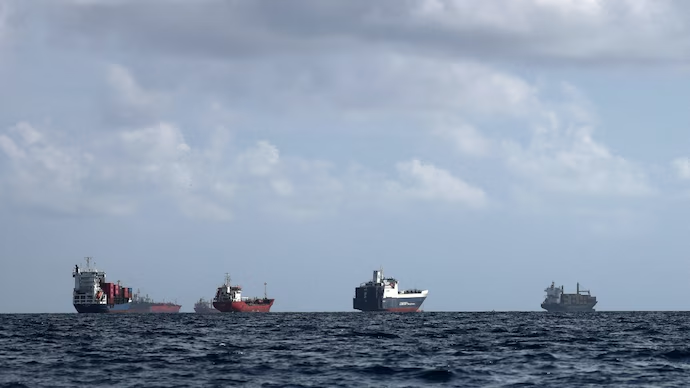
A US intelligence report has assessed that Iran possesses the capability to shut down the Strait of Hormuz at will, wielding what officials describe as a weapon more strategically consequential than nuclear capability due to its immediate impact on global energy supplies.
The assessment underscores Iran’s arsenal of anti-ship missiles, naval mines, and unmanned systems positioned along the Persian Gulf. These platforms give Tehran the ability to disrupt approximately 20 percent of the world’s seaborne oil trade that transits through the 21-mile-wide chokepoint daily.
The Strait of Hormuz, lying between Iran and Oman, connects the Persian Gulf to the Gulf of Oman and the Arabian Sea. Any sustained blockade would immediately trigger global energy price spikes and geopolitical cascades affecting economies worldwide, particularly energy-dependent nations in Asia, Europe, and beyond.
Iran’s anti-ship arsenal includes the Khalij Fars, Qader, and Khalifeh cruise missiles, along with fast-attack craft capable of rapid harassment operations. The Islamic Revolutionary Guard Corps Navy operates these systems from coastal bases and islands throughout the Persian Gulf, creating a layered defence network that US analysts believe could overwhelm conventional counter-blockade operations in the confined waters.
India, as a major importer of Iranian oil historically and a significant consumer of Gulf energy, maintains strategic interest in maintaining freedom of navigation through the Strait. The Indian Navy regularly deploys task forces in the Arabian Sea and Gulf of Oman as part of its broader Indo-Pacific strategy, with operations coordinated under the larger framework of protecting India’s sea lanes of communication.
For New Delhi, energy security remains a core pillar of national strategy. Approximately 80 percent of India’s oil imports transit through the Strait of Hormuz, making any disruption a direct threat to India’s economic stability and defence preparedness. This dependence has prompted India to diversify energy sourcing, strengthen ties with Gulf states, and maintain robust naval presence in the region.
The US assessment also reflects broader concerns about Iran’s maritime asymmetric capabilities. Unlike conventional navies, Iran leverages unmanned systems, decentralised command structures, and willingness to accept attrition to create strategic friction at minimal cost. This asymmetric approach has become a model studied by defence planners globally, including in India’s strategic community.
India’s maritime doctrine, articulated through the Indian Navy’s stated roles, includes protection of national maritime interests and maintenance of sea lane security. The assessment reinforces the imperative for India to continue modernising its naval strike capabilities, air defence systems, and intelligence networks in the Arabian Sea and surrounding waters.
-

-

-

-