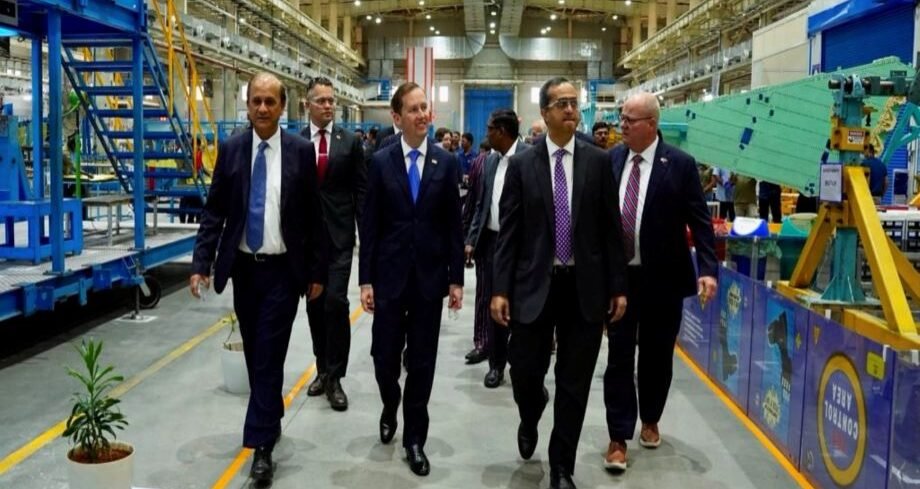
India is taking on a larger role in the international aerospace manufacturing network, with the country’s capabilities in the C-130J Super Hercules programme drawing attention from the United States. US Ambassador to India Sergio Gor recently visited the Tata Lockheed Martin Aerostructures Limited (TLMAL) facility in Hyderabad, highlighting the importance of Indian industry to the global production ecosystem.
The Hyderabad facility is a joint venture between Tata Advanced Systems Limited and Lockheed Martin Aeroframe Corporation. Since its establishment, the venture has developed specialised capabilities for producing major aerostructures for military aircraft. The plant is particularly important to the C-130J programme because it serves as the global single-source supplier of empennages for the C-130J and LM-100J aircraft. It also produces other major structures, including centre wing components.
The facility’s role illustrates how India’s private aerospace sector is moving beyond supporting domestic defence requirements and becoming part of international aircraft supply chains. For Lockheed Martin, the partnership provides an established manufacturing base in India, while for Indian industry it creates opportunities to develop expertise in advanced aerostructure production and international quality standards.
The cooperation is also being considered for expansion. Tata Advanced Systems and Lockheed Martin have been exploring additional C-130J opportunities in India, including the possibility of establishing a Maintenance, Repair and Overhaul facility. Such a capability could support the Indian Air Force’s existing fleet of 12 C-130J aircraft while potentially providing services to other operators.
Another potential area is India’s Medium Transport Aircraft programme. The requirement is expected to cover approximately 60–80 aircraft as the country looks to modernise its transport fleet. The C-130J is among the platforms associated with the competition, alongside other international transport aircraft. If the programme moves forward with an Indian production component, the existing Tata-Lockheed Martin industrial relationship could provide a foundation for expanded manufacturing or assembly activities in the country.
The significance of the Hyderabad facility extends beyond the C-130J itself. The partnership has also contributed to the development of Telangana’s aerospace and defence manufacturing ecosystem, while discussions over potential future investments indicate the possibility of expanding India-based production capabilities.
For India, greater involvement in a globally established aircraft programme supports the government’s wider objective of strengthening domestic defence manufacturing and integrating Indian companies into international supply chains. It can also help create high-skilled employment and develop capabilities that can be applied to other aerospace and defence programmes.
For the United States, stronger manufacturing links with India offer another avenue for building resilient defence supply chains. The cooperation therefore forms part of a broader shift in India-US defence relations, with industrial partnerships and manufacturing increasingly complementing traditional defence procurement.
The C-130J is already an important transport platform for the Indian Air Force, particularly for missions requiring tactical airlift capabilities. India’s growing contribution to its global production network now gives the country a more significant position in the aircraft’s international industrial ecosystem.
Sergio Gor’s visit to the Hyderabad facility consequently highlights a broader development in India’s aerospace sector: the country is increasingly becoming a manufacturing partner in major global defence programmes rather than remaining solely an aircraft customer. Continued progress in C-130J manufacturing, MRO and potential future assembly could further strengthen that position.
-

-

-

-