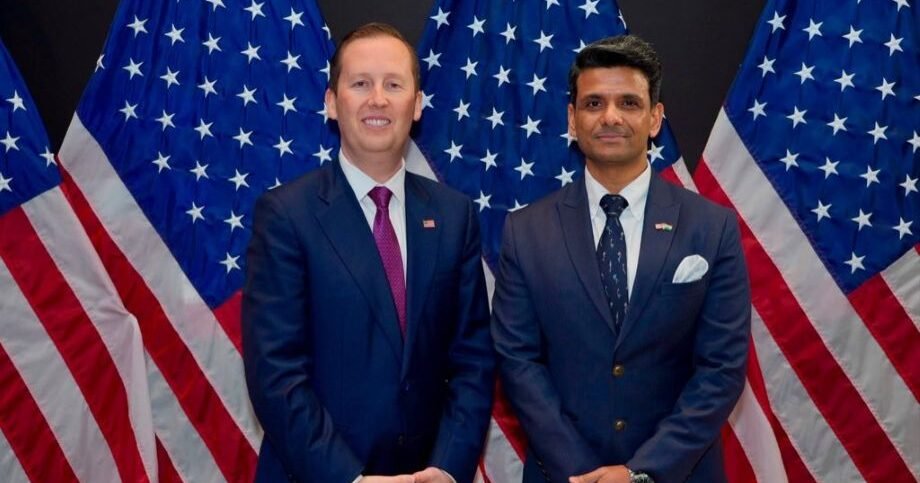
U.S. Ambassador to India Sergio Gor has highlighted Indian astronaut Group Captain Shubhanshu Shukla’s journey to the International Space Station (ISS) as a prominent example of the growing partnership between India and the United States in space exploration.
Gor met Shukla in Bengaluru on Sunday and praised his journey from training with NASA to serving as the mission pilot of Axiom Space’s Ax-4 mission. The U.S. envoy described the experience as a strong demonstration of what closer cooperation between the two countries can achieve in human spaceflight.
Shukla became the first Indian astronaut to travel to the International Space Station when the Ax-4 mission launched on June 25, 2025. The mission returned to Earth on July 15, 2025, giving India valuable operational and scientific experience in human spaceflight.
The significance of Shukla’s mission extends beyond his individual achievement. According to Gor, cooperation following the Ax-4 mission is moving towards areas such as docking standards, interoperability and astronaut training. Such collaboration could help strengthen India’s capabilities as it develops increasingly ambitious human spaceflight missions.
The development comes as India and the United States are expanding their space partnership across multiple areas. Gor has also pointed to the NASA-ISRO collaboration on the NISAR satellite as another example of joint technology producing practical benefits. The mission combines NASA and ISRO capabilities for Earth observation and disaster-related applications.
Washington is also seeking a larger Indian role in future lunar exploration. Speaking at the Bengaluru Space Expo 2026, Gor said NASA has invited ISRO to participate in its Moon base programme, while emphasising India’s position as a signatory to the Artemis Accords. The remarks signal an ambition to take bilateral space cooperation beyond Earth orbit towards long-term lunar exploration.
The U.S. envoy has further encouraged Indian space startups to explore opportunities in the American market, pointing to the expanding role of private companies in India’s space ecosystem. He highlighted firms working across satellite technology, Earth observation, launch systems and other emerging space technologies.
For India, the expanding relationship with the United States could provide additional opportunities in astronaut training, scientific research, space technology and future exploration missions. At the same time, India’s growing private space sector is creating new avenues for commercial and technological cooperation between the two countries.
Shukla’s ISS mission has therefore emerged as more than a milestone in India’s human spaceflight programme. It has also become a visible symbol of the increasingly broad India-U.S. partnership in space, with cooperation now extending from astronaut missions and scientific research to lunar exploration, advanced technologies and the emerging global space economy.
-

-

-

-