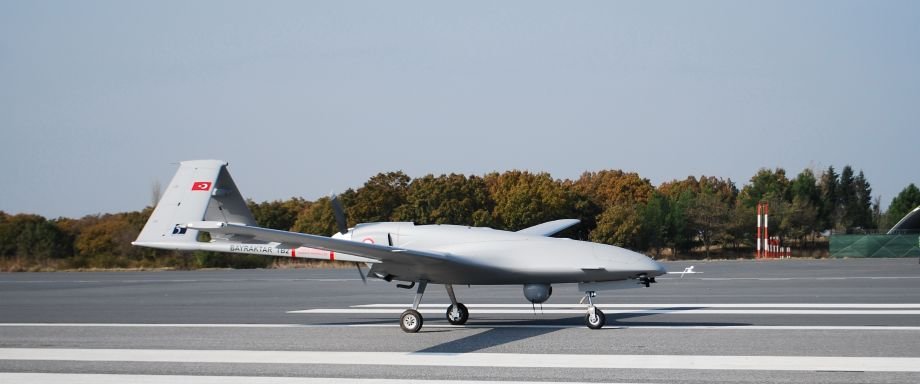
Turkey is exploring a new direction in unmanned military aviation by transforming its widely used Bayraktar TB2 into an airborne launch platform for smaller attack drones. The latest demonstration by Turkish defence manufacturer Baykar highlights how existing unmanned aircraft could be adapted to carry and deploy multiple compact systems during a single mission.
During the reported flight trial on November 4, 2026, a Bayraktar TB2 took off carrying 16 Skydagger first-person-view (FPV) kamikaze drones. The demonstration took place at Baykar’s Keşan Flight Training and Test Center in Edirne, Türkiye. During the flight, the larger aircraft released two of the smaller drones, which subsequently struck their designated targets.
The test represents an interesting development in the use of unmanned aircraft because it combines two different categories of aerial systems. The TB2 provides extended flight endurance and an elevated operating position, while the smaller FPV drones are designed for more direct and precise attacks against selected targets.
One of the most significant aspects of the demonstration was the communication arrangement between the aircraft and the released drones. The Bayraktar TB2 reportedly maintained a connection that allowed ground-based operators to control the smaller FPV systems after their release. This capability could be particularly useful in situations where conventional communication links between ground operators and small drones are restricted by terrain or distance.
Small FPV drones have become an increasingly important part of modern military operations. Their compact design, relatively affordable production costs and ability to manoeuvre close to targets have made them attractive for different battlefield applications. However, their limited battery capacity and communication range can restrict their effectiveness. Deploying them from a larger aircraft could help address some of these limitations by bringing them closer to their intended operating areas.
The Bayraktar TB2 already has an established role in Turkey’s military aviation sector. Developed by Baykar, the platform is designed for intelligence, surveillance, reconnaissance and armed missions. Its endurance and ability to carry precision-guided weapons have contributed to its international popularity, with several countries acquiring the aircraft for their defence requirements.
The new configuration could introduce additional flexibility to the platform. Rather than relying exclusively on its own onboard weapons, the TB2 could potentially support missions involving several smaller unmanned aircraft. Such an arrangement may allow military operators to distribute surveillance and attack responsibilities across different platforms.
The demonstration also reflects a wider transformation taking place in defence technology, where military planners are increasingly interested in coordinated unmanned operations. Integrating larger aircraft with smaller drones could create new possibilities for aerial deployment, communication support and multi-directional engagements.
Nevertheless, the successful test should not be confused with confirmation that the system is already fully operational. Further information about its effective deployment range, endurance, simultaneous control capacity and military integration has yet to be established publicly.
For Turkey, the development demonstrates Baykar’s continued efforts to expand the capabilities of its existing unmanned platforms. The combination of the Bayraktar TB2 and Skydagger FPV drones could become an important area of future development as military forces explore more flexible and interconnected drone systems.
-

-

-

-