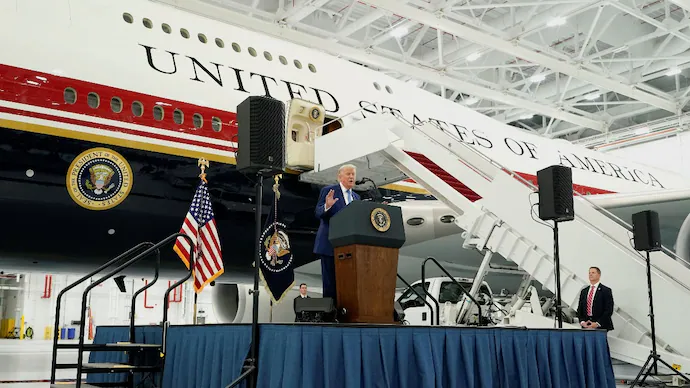
The United States has revealed modifications to a Boeing 747 aircraft being prepared for use as Air Force One under the Trump administration, according to reports on the presidential plane’s interior systems and security architecture.
The aircraft, a heavily customised variant of the commercial 747-8F freighter, has undergone extensive military-grade modifications to serve as the primary transport for the sitting US President. These alterations extend far beyond cosmetic changes, encompassing communications, defensive systems, and operational capabilities that position it as a flying command centre capable of managing national security operations from any location globally.
The 747 platform has served as Air Force One for decades, with the current generation entering service in the 1990s. The aircraft operates at a maximum range exceeding 8,000 nautical miles without refuelling, enabling intercontinental travel without intermediate stops. Its size, payload capacity, and altitude performance make it uniquely suited for the presidential mission profile where redundancy, self-sufficiency, and operational continuity are non-negotiable requirements.
Inside, the aircraft carries sophisticated communications suites enabling the President to maintain command authority over military and civilian agencies while airborne. The plane is equipped with advanced electronic countermeasures and defensive avionics designed to detect and respond to air threats. These systems are integrated across multiple redundant networks to ensure operational resilience in contested environments.
The cabin layout includes dedicated spaces for presidential staff, security details, media representatives, and senior officials. Environmental control systems maintain pressurisation and life support across the entire fuselage independent of external power sources. The aircraft can generate its own electrical power and maintain operations for extended periods without ground support.
From an Indian defence perspective, the Air Force One programme underscores the operational criticality of maintaining national leadership mobility and command continuity. India’s own VIP transport fleet, including the Boeing 787 Dreamliners and Airbus aircraft operated by the Indian Air Force, incorporates similar principles of hardening, redundancy, and self-sufficiency. The emphasis on electronic protection and autonomous operations reflects a global defence priority that spans all major powers.
The transition to new Air Force One platforms represents a multi-year, multi-billion dollar commitment reflecting the centrality of executive mobility to national security strategy. The 747’s successor aircraft, currently under development, will incorporate next-generation communications, threat detection, and defensive systems aligned with evolving geopolitical challenges.
-
-
-
-