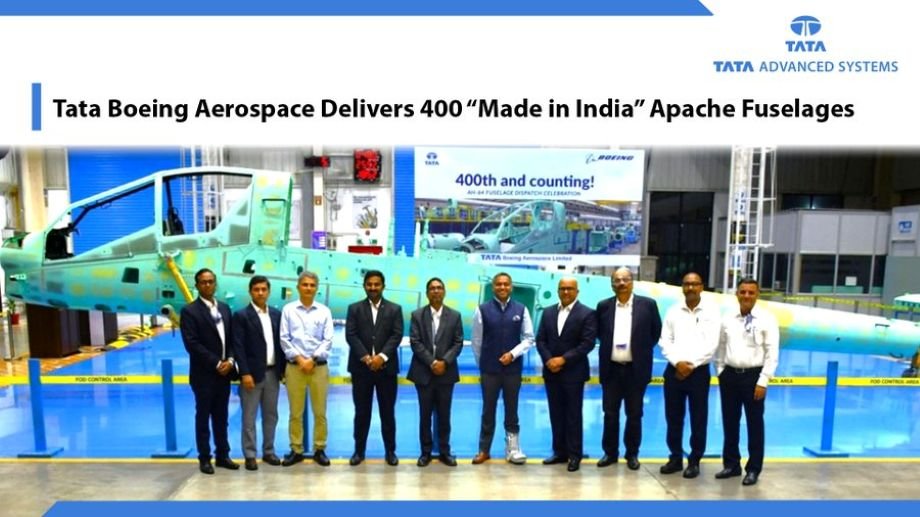
India’s aerospace manufacturing sector has reached another significant milestone with Tata Boeing Aerospace Limited (TBAL) completing its 400th fuselage for the AH-64E Apache attack helicopter at its Hyderabad facility.
The achievement underlines the expanding capabilities of Indian industry in manufacturing complex aerostructures for one of the world’s most widely operated attack helicopters. The Apache fuselages produced in Hyderabad are subsequently used in the assembly of complete helicopters for customers in India and other countries.
Tata Boeing Aerospace was established as a joint venture between Tata Advanced Systems Limited (TASL) and Boeing, with the Hyderabad facility playing a key role in the companies’ efforts to develop an advanced aerospace manufacturing ecosystem in India. The facility covers approximately 52,000 square metres and incorporates modern manufacturing technologies, including automation and robotics.
The production of the 400th Apache fuselage is particularly important because the Hyderabad operation is integrated into Boeing’s international Apache supply chain. Rather than serving only the Indian market, the facility contributes aerostructures to a global programme, demonstrating the increasing ability of Indian manufacturing units to meet the demanding quality and production requirements of international defence platforms.
TBAL’s workforce includes hundreds of engineers and technicians involved in the manufacture of Apache structures. Their involvement reflects the development of specialised skills in areas such as aerospace fabrication, structural assembly, precision manufacturing and quality assurance.
The Apache programme also has a direct connection with India’s military aviation requirements. The Indian Air Force operates 22 AH-64E Apache helicopters, while the Indian Army received its first six Apache helicopters in 2025. The platform provides Indian forces with a highly capable attack helicopter designed for missions including anti-armour operations, close air support and battlefield engagement.
The 400th fuselage milestone comes at a time when India is seeking to move beyond being primarily a defence equipment buyer and become a more significant producer and exporter within the international defence industry. Manufacturing components for globally deployed military platforms is an important part of that transition.
The development also coincides with a separate initiative involving Tata Advanced Systems and the Javelin Joint Venture, formed by Raytheon and Lockheed Martin. The companies have signed a memorandum of understanding to explore the potential co-production of Javelin missiles in India. The proposed cooperation could create additional opportunities for local manufacturing, assembly and integration of advanced defence systems.
Taken together, these developments point to a broader expansion of India’s role in international defence production. The Apache programme demonstrates established capability in aerospace structural manufacturing, while the proposed Javelin cooperation could extend Indian industrial participation into another area of advanced weapons production.
For Tata Boeing Aerospace, reaching the 400-fuselage mark represents more than a numerical production target. It demonstrates that an Indian facility has developed the capacity to consistently manufacture sophisticated aerostructures for a major international military aviation programme.
As India continues to encourage domestic defence production and greater private-sector participation, milestones such as the 400th Apache fuselage are likely to remain important indicators of the country’s progress in building a stronger and more globally connected aerospace and defence manufacturing base.
-

-

-

-