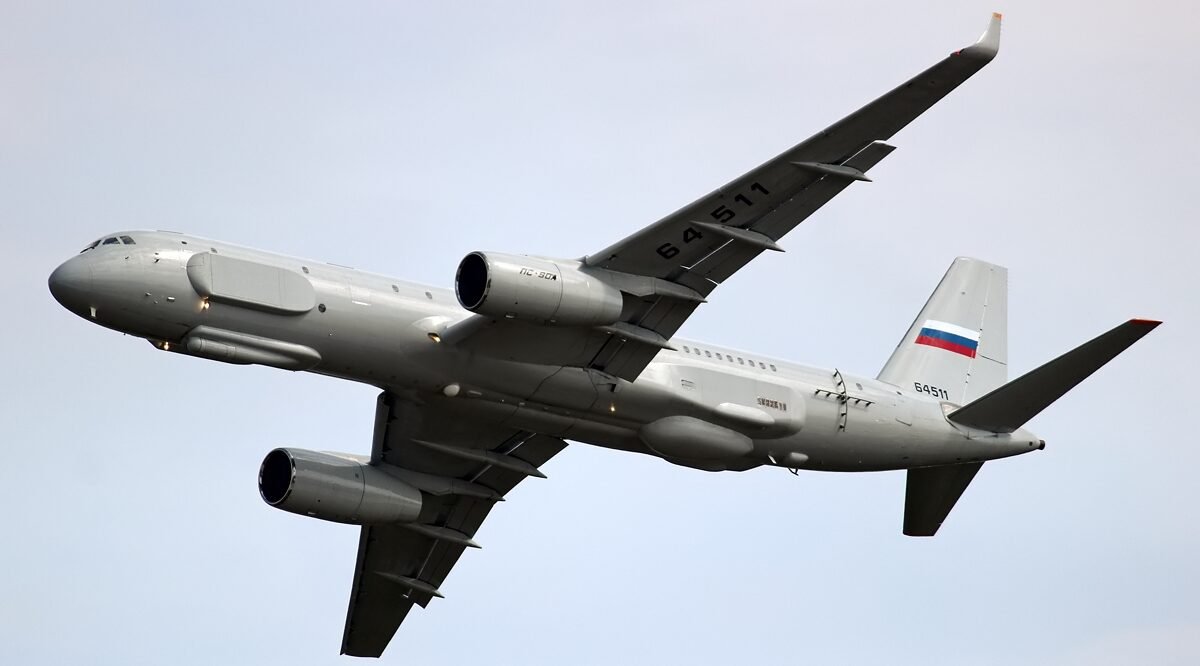
Russia has deployed its Tu-214PU airborne command post aircraft to Tehran, marking an intensification of Moscow’s military support to Iran as US-Iran hostilities escalate.
The Tu-214PU is a Russian airborne early warning and command aircraft derived from the Tu-214 transport platform. It serves as a flying command centre, equipped with advanced radar and communications systems designed to coordinate military operations across large geographical areas and relay tactical information to ground and airborne units in real time.
The platform is built on the Tu-214 airframe, a Soviet-era twin-engine transport jet that Russia has modernised with contemporary avionics and sensor packages. The PU variant specifically integrates an L-band phased array radar mounted in a dorsal canoe radome, enabling it to detect and track aircraft, ships, and ground formations at extended ranges. The system also functions as a relay node for secure military communications.
This deployment reflects Russia’s deepening military-technical cooperation with Iran, particularly as both nations face Western sanctions and diplomatic isolation. The Tu-214PU’s arrival in Tehran suggests Moscow is providing Iran with advanced command and control capabilities that would enhance coordination of air defence systems, missile operations, and broader military responses to potential strikes.
For India, Russia’s expanding military footprint in the Middle East and its willingness to deploy elite sensor platforms carries strategic implications. India maintains significant defence partnerships with both Russia and Iran, and also operates sophisticated air defence and surveillance systems sourced from Russian manufacturers. The deployment pattern reflects how major powers are repositioning military assets in response to shifting regional tensions.
The Tu-214PU is comparatively rare in operational service globally. Russia operates only a handful of these aircraft, making their deployment a significant commitment. The platform complements Russia’s existing air support to Iran, which includes advanced air defence radar systems and fighter aircraft. India’s own air defence modernisation programmes, including Russian-origin systems like the S-400 air defence network, operate on comparable principles of centralised command and distributed radar coverage.
The geopolitical context underscores how advanced airborne command platforms have become critical to military operations in contested airspace. As Iran faces potential strikes from US and Israeli forces, acquiring command and control capabilities allows better coordination of its layered air defence networks and offensive missile systems.
-

-
-

-