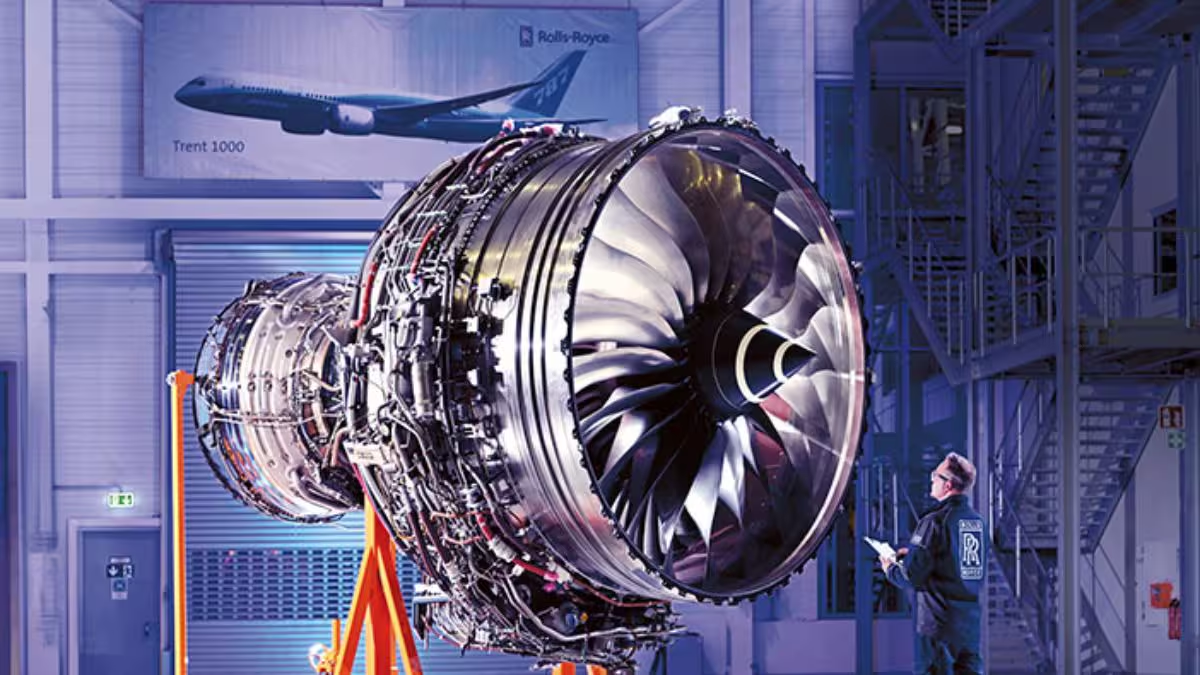
Rolls-Royce has renewed its effort to secure a contract for powering India’s fifth-generation fighter aircraft, signalling fresh momentum in one of the defence sector’s most strategically significant engine programmes.
The British aero-engine manufacturer’s renewed approach comes as India accelerates development of the Advanced Medium Combat Aircraft (AMCA), the indigenous fifth-generation fighter being developed by Hindustan Aeronautics Limited (HAL) under DRDO oversight. The AMCA programme represents a cornerstone of India’s fighter acquisition strategy and technological self-reliance agenda.
India’s indigenous fighter engine development remains nascent. DRDO’s Gas Turbine Research Establishment (GTRE) has been working on the Kaveri engine for decades, originally conceived to power the Tejas light combat aircraft. While Tejas entered service with the Indian Air Force in 2016, it operates on foreign engines, primarily the General Electric F404, highlighting persistent gaps in India’s indigenous propulsion capability for advanced combat aircraft.
The AMCA programme demands substantially greater power and performance than Tejas requires. A fifth-generation fighter necessitates engines with higher thrust ratings, advanced materials for sustained supersonic flight, supercruise capability, and thermal management systems capable of withstanding extreme operational stresses. These demands position engine development as among the most technologically demanding components of the AMCA project.
Rolls-Royce brings extensive credentials in high-performance military engines. Its participation in joint ventures and strategic partnerships has given it insights into India’s defence ecosystem and procurement preferences. The company has prior exposure to Indian defence programmes through various technical collaborations and supply agreements with HAL and other Indian defence organisations.
The engine selection for AMCA will be consequential for India’s strategic autonomy. A domestically designed and developed engine would validate DRDO and GTRE capabilities and reduce long-term operational dependence on foreign suppliers. Conversely, indigenous development risks extended timelines and technical challenges that could delay the entire AMCA programme, potentially compelling India to adopt foreign powerplants as an interim or permanent solution.
India’s Make in India initiative prioritises indigenous development of critical defence systems. However, the defence ministry has increasingly embraced pragmatic partnerships where foreign technology transfer can accelerate capability building without sacrificing timeline or performance. An engine partnership with an established manufacturer like Rolls-Royce could provide technical foundation while building Indian design and manufacturing capacity.
The AMCA is central to India’s vision of maintaining air superiority through the 2040s and beyond. First flight is targeted in the early 2030s, with series production to follow. Engine finalisation typically precedes detailed aircraft design maturation, making the powertrain selection an imminent decision point in the programme’s trajectory.
-
-
-

-