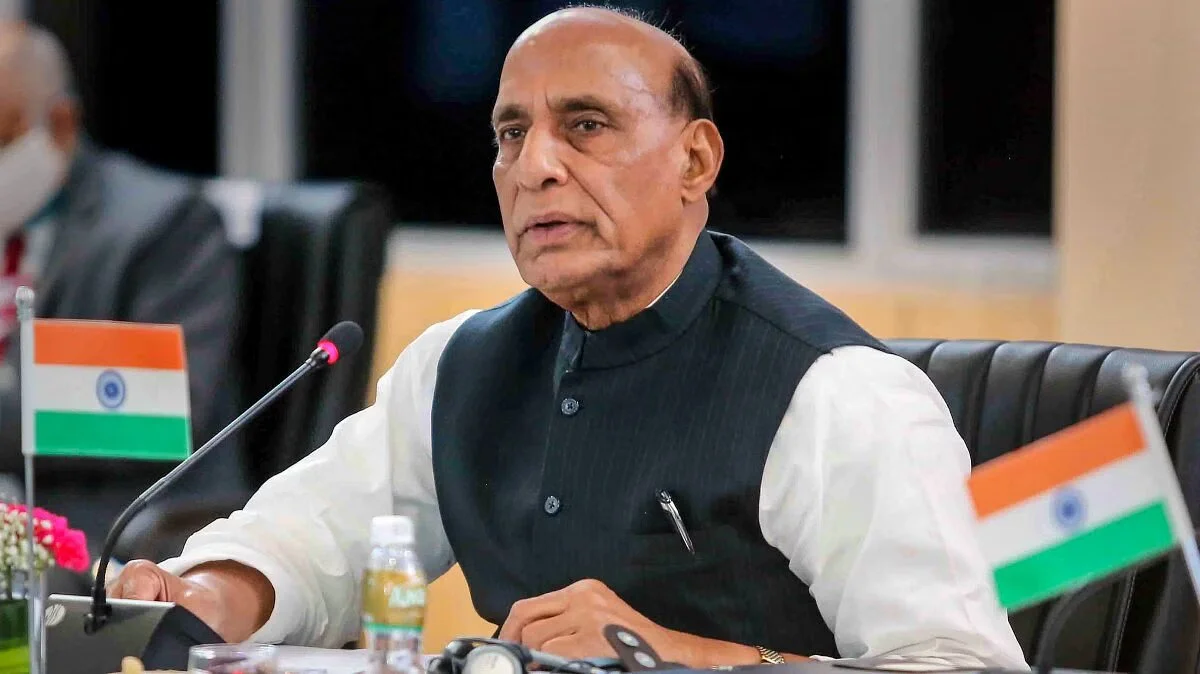
Defence Minister Rajnath Singh has hailed the commissioning of three naval vessels as a significant milestone in strengthening India’s maritime operational capability, according to reports. The tri-commissioning underscores the Indian Navy’s continued modernisation and the acceleration of indigenous warship construction under India’s Make in India initiative.
The three vessels represent a mix of platform classes that expand the Navy’s reach across multiple operational domains. India’s warship construction programme, driven by the Ministry of Defence and supported by both government and private shipyards, has progressively shortened build cycles and enhanced indigenisation levels in recent years.
The Indian Navy operates one of the world’s largest fleets of indigenously designed and built warships. Over the past decade, platforms ranging from guided-missile corvettes and frigates to offshore patrol vessels and mine countermeasure ships have joined service, significantly reducing India’s dependence on foreign acquisitions for surface combatants. These vessels are equipped with indigenous fire-control systems, sonars, and combat management systems developed by DRDO and Naval Science and Technological Laboratory (NSTL).
The tri-commissioning aligns with India’s broader maritime strategy to maintain operational dominance in the Indian Ocean Region. With expanding trade routes, growing naval presence from extra-regional powers, and evolving security challenges including maritime terrorism and piracy, the Navy has prioritised rapid augmentation of its surface fleet. Each commissioned vessel adds to the Navy’s capacity for sustained operations across vast ocean areas and enables extended deployments in strategically vital waters.
The three vessels also reflect progress in India’s naval shipbuilding ecosystem. Government shipyards such as Cochin Shipyard and Mazagon Dock Shipbuilders, along with private partners including Reliance Defence and Goa Shipyard, have collaborated to deliver platforms that meet modern combat requirements while maintaining affordability. Indigenous production of key combat systems has reduced lead times and enabled customisation to specific operational roles.
Singh’s statement underscores the government’s commitment to reducing the Navy’s equipment acquisition timeline and enhancing self-reliance in defence manufacturing. With multiple frigates, corvettes, and submarines in various stages of construction across Indian yards, the pipeline of future commissionings will sustain the modernisation momentum through this decade, strengthening India’s deterrent posture and operational readiness in the maritime domain.
-

-

-

-