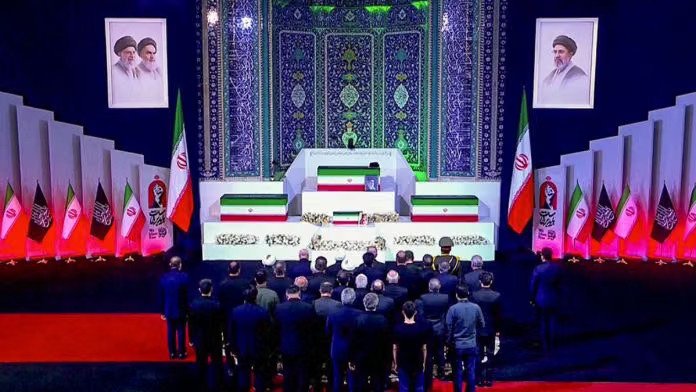
Thousands gathered at Ali Khamenei’s funeral in Iran on Tuesday amid chants of ‘Kill Trump’ and ‘Death to America’, according to reports, signalling a sharp escalation in regional rhetoric as Iran’s top leadership re-emerges after a period of reduced public visibility.
The funeral processions across Iranian cities underscore deepening anti-American sentiment at a critical moment when geopolitical tensions across the Middle East remain elevated. The timing and tone of the demonstrations reflect Iran’s domestic political consolidation following leadership transitions and its strategic posturing in a volatile region.
For India, Iran remains a key strategic partner in South Asia’s extended neighbourhood. New Delhi has long maintained a calibrated diplomatic engagement with Tehran, balancing ties with both Iran and the Gulf Cooperation Council states, particularly Saudi Arabia and the UAE. India’s energy security is partly dependent on Iranian oil supplies, and the Chabahar Port project represents a cornerstone of India’s broader Indo-Pacific connectivity strategy.
The escalation of anti-American rhetoric at such a high-profile state event signals that Iran may be moving towards a more assertive regional posture. This carries implications for Indian strategic interests. Any intensification of US-Iran tensions could destabilise the Gulf region, disrupt energy markets, and complicate India’s defence partnerships with Gulf nations, particularly in naval cooperation and counter-terrorism operations in the Indian Ocean Region.
India’s Ministry of External Affairs typically maintains a position of studied neutrality in US-Iran disputes, focusing instead on protecting Indian nationals, securing energy supplies, and advancing connectivity projects. However, any major regional conflict would force New Delhi to navigate competing pressures from both the United States (a key strategic partner and defence technology supplier) and Iran (a historical civilisational and energy partner).
The Indian Navy’s operations in the Persian Gulf and Arabian Sea, including anti-piracy patrols and freedom of navigation exercises, depend on regional stability. Increased tensions would impose additional operational and diplomatic burdens on the service. Similarly, India’s defence procurement from the US, including the P-8I maritime patrol aircraft and other platforms crucial to the Navy’s surveillance capabilities, underscores the strategic stakes involved.
India’s approach to West Asia remains driven by pragmatism: securing energy, protecting diaspora communities, and advancing infrastructure projects without being drawn into great-power rivalries. The funeral rhetoric, while domestic in its immediate context, underscores the volatility New Delhi must navigate in one of the world’s most consequential regions.
-

-
-

-