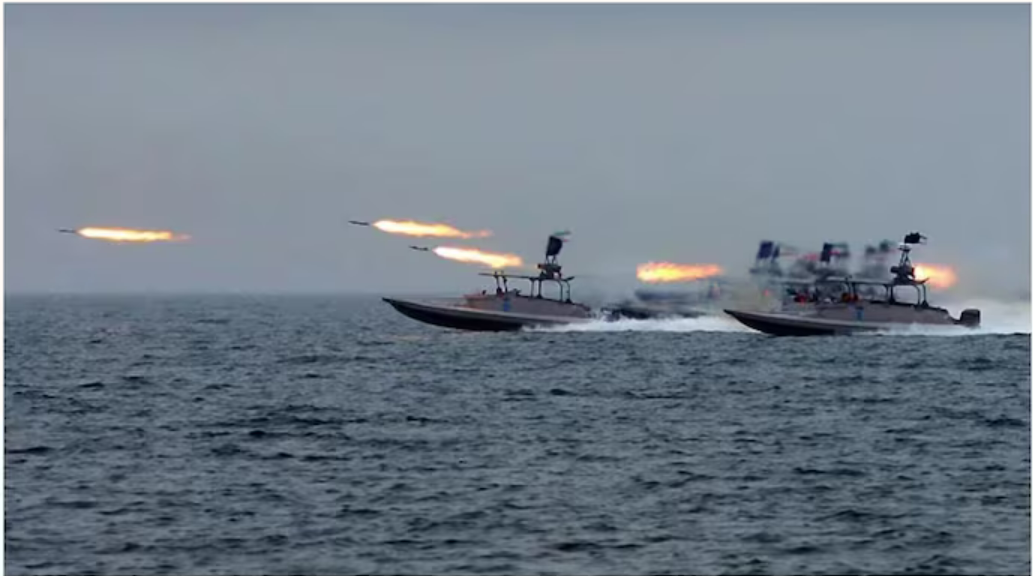
Iran has launched drone attacks against commercial vessels transiting the Strait of Hormuz, according to reports, marking a significant escalation in regional tensions despite recent diplomatic overtures with the United States.
The attacks underscore the persistent threat posed by unmanned systems in one of the world’s most critical maritime chokepoints. The Strait of Hormuz handles roughly one-third of global seaborne oil trade, making stability in the waterway a matter of strategic concern for nations far beyond the Gulf region, including India.
India maintains substantial maritime interests in the Persian Gulf and Hormuz Strait. The Indian Navy regularly deploys vessels to the region as part of anti-piracy and maritime security operations, including rotational deployments of guided-missile destroyers and frigates tasked with protecting Indian-flagged merchant vessels and ensuring freedom of navigation.
The use of unmanned aerial systems in targeting commercial shipping reflects evolving asymmetric tactics that challenge conventional naval air defence architecture. The Indian Navy has progressively upgraded its layered air defence systems across its fleet to counter drone threats, integrating short-range air defence guns, missile systems, and electronic warfare suites aboard modern platforms including the Kolkata-class and Visakhapatnam-class destroyers.
India’s defence establishment has invested substantially in counter-unmanned aircraft systems (C-UAS) capabilities both for the armed forces and civilian infrastructure protection. The DRDO has been developing integrated air defence solutions combining radar surveillance, command-and-control networks, and kinetic engagement systems to address the growing threat from hostile drones at varying altitudes and ranges.
The incident reinforces India’s strategic imperative to maintain naval presence and surveillance capabilities in the Arabian Sea and Gulf region. The Indian Navy’s long-range maritime reconnaissance aircraft, including the P-8I Neptune platform, provide critical situational awareness across these waters. Advanced radar and signals intelligence systems enable real-time threat detection and coordinated response.
For Indian shipping interests, the escalation complicates an already challenging operational environment. Merchant vessels transiting the Strait face insurance premium increases, rerouting costs, and potential delays. India’s merchant marine and petroleum sector depend on stable Hormuz passage for energy imports and trade flows worth billions annually.
The attacks also underscore the interconnection between regional security dynamics and India’s broader Indo-Pacific maritime strategy. Instability in the western Indian Ocean directly affects India’s sea lanes of communication and economic interests, reinforcing the rationale for enhanced naval capabilities and sustained operational deployments in the region.
-

-

-

-