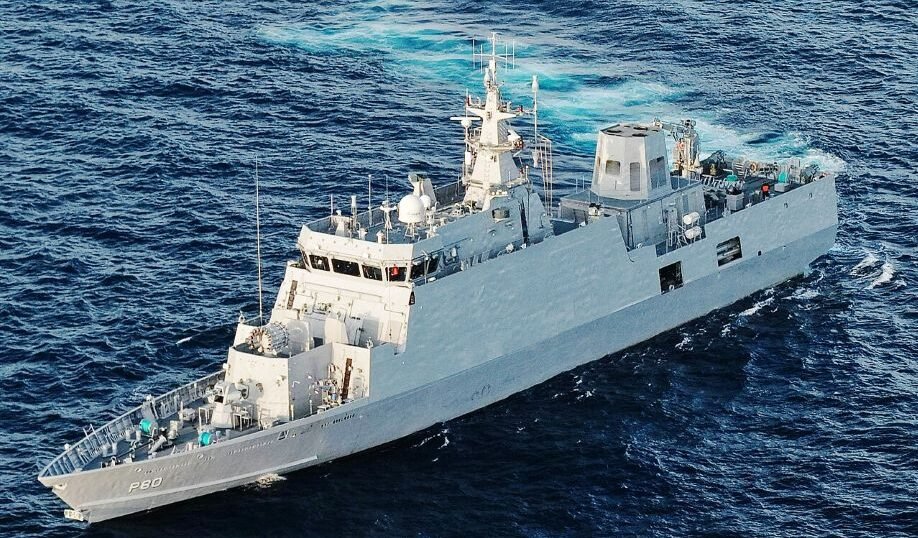
The Indian Navy commissioned INS Malvan, the second Mahe-class Anti-Submarine Warfare Shallow Water Craft, at the Karwar naval base in Karnataka on 22 July. The warship, built by Cochin Shipyard Limited with over 80% indigenous content, represents a significant milestone in India’s maritime defence capabilities and self-reliance in naval shipbuilding.
Air Chief Marshal AP Singh presided over the commissioning ceremony, emphasizing the strategic importance of maritime security in the Indian Ocean region. The event was attended by Vice Admiral Sanjay Vatsayan, flag officer commanding-in-chief of the western naval command, senior naval officers, and representatives from Cochin Shipyard.
INS Malvan is the first Indian naval warship to be commissioned at Karwar, underscoring the shift in India’s naval infrastructure development. Vice Admiral Vatsayan noted that the vessel represents the seventh warship inducted into the Navy this year, with another 12 vessels expected to join the fleet, signaling an accelerated pace of naval expansion.
The Mahe-class programme comprises eight vessels designed specifically for coastal and shallow-water operations. These craft are optimized to detect, track, and engage enemy submarines while conducting coastal surveillance, search and rescue missions, and low-intensity maritime security operations in waters where deeper-draft vessels cannot operate effectively.
INS Malvan displaces between 896 and 1,100 tonnes and measures 78 metres in length. The vessel achieves a maximum speed of 25 knots and operates with a range of 1,800 nautical miles at 14 knots, providing an endurance of 14 days. Three marine diesel engines producing 6 megawatts of power drive the ship through water-jet propulsion, making these among the largest Indian Navy warships to employ this propulsion system.
Water-jet propulsion offers distinct advantages in shallow-water environments, delivering high maneuverability and shallow draft compared to conventional screw propellers. This technology reduces vulnerability to bottom strikes in littoral zones and enhances agility during complex anti-submarine operations.
The Mahe-class fills a critical gap in India’s naval order of battle. Unlike larger frigates and corvettes designed for open-ocean operations, these craft provide persistent surveillance and underwater threat detection in the complex, shallow waters surrounding India’s coastline and strategically important island territories. Each vessel carries integrated sonar systems and anti-submarine weaponry suitable for the shallow-water acoustic environment.
The 80% indigenous content reflects the growing maturity of India’s defence industrial base, particularly in marine engineering and systems integration at Cochin Shipyard. This level of localization reduces foreign exchange outflow and builds domestic expertise in naval shipbuilding, a key pillar of the Atmanirbhar Bharat initiative.
With seven warships commissioned this calendar year and another dozen in the pipeline, the Indian Navy is executing one of the fastest carrier-capable ship expansion programmes in its history. The induction of the Mahe-class vessels complements ongoing construction of Project 75(I) submarines, Project 17A frigates, and Survey Vessel (Large) units.
-

-

-

-