The Indian Army has established an advanced integrated drone and virtual reality training laboratory in the high-altitude Ladakh region, according to official sources. The facility represents a significant modernisation push in the Army’s approach to operational readiness in one of India’s most strategically critical and geographically challenging theatres.
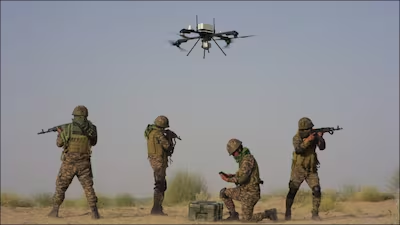
The lab integrates unmanned aerial systems with immersive virtual reality simulation technology, allowing troops to train on drone operations, reconnaissance, and tactical coordination without requiring repeated field deployments in extreme conditions. This hybrid training model is particularly suited to Ladakh’s terrain, where altitude, weather, and logistics constraints make continuous live training prohibitively expensive and operationally risky.
Ladakh has emerged as a focal point for Indian military modernisation since the 2020 border standoff with China. The region’s strategic importance has driven investment in advanced training infrastructure, medical facilities, and indigenous weapon systems capable of operating in extreme cold and thin-air environments. The Army has progressively upgraded its presence across multiple sectors, including air defence, mechanised infantry, and special operations forces.
The integration of drone training with VR platforms reflects broader Indian military doctrine shifts toward network-centric warfare and autonomous systems. DRDO has been actively developing indigenous drone platforms across multiple weight categories, while the Army’s training establishments have increasingly adopted simulation-based learning to compress operational timelines and reduce platform wear. Virtual reality environments enable repetitive scenario training, tactical decision-making under stress, and collaborative multi-unit operations planning without logistical overhead.
This facility aligns with the Army’s 2023-2035 modernisation roadmap, which prioritises capabilities in high-altitude conflict, integrated air defence, and unmanned systems. Similar training labs have been established at formation headquarters and brigade-level units across northern commands, but the Ladakh installation’s high-altitude specifications make it a unique operational testbed.
The lab’s commissioning also reflects India’s broader push toward self-reliance in defence technology. Training infrastructure developed indigenously reduces dependence on foreign simulation systems and creates a feedback loop for DRDO’s drone development programme, enabling rapid iteration between platform designers and end-user operators.
Personnel from mechanised units, infantry formations, and engineer corps will rotate through the facility for structured training cycles. The VR component allows commanders to rehearse responses to emerging threats, including swarm drone scenarios and complex mountain terrain operations, before committing forces to field exercises.
-

-

-

-