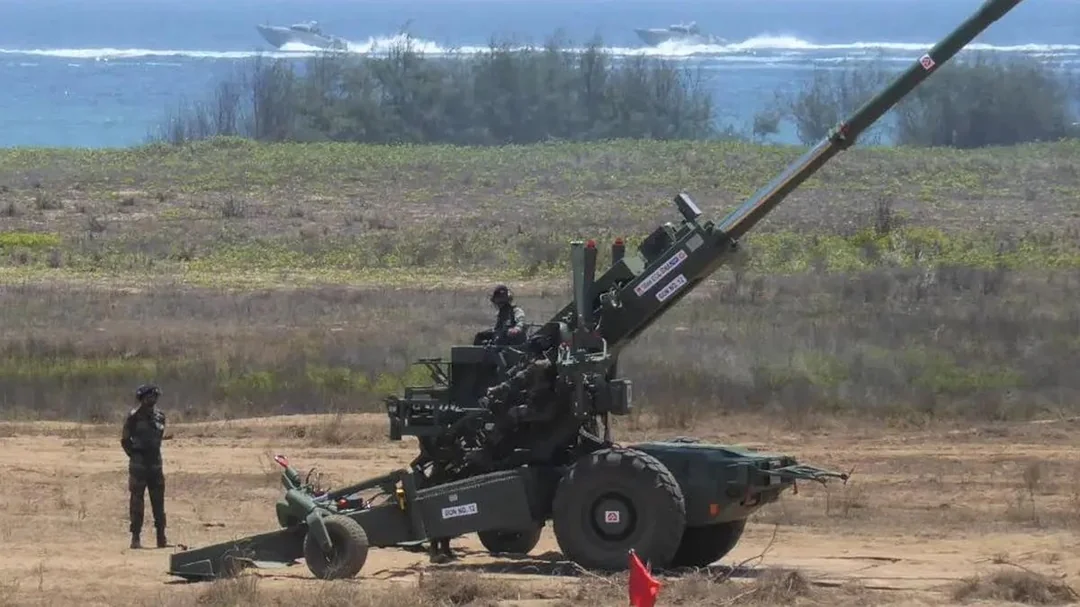
The Indian Army has integrated automatic aiming capability into its artillery gun systems, significantly enhancing targeting precision and rate of fire across its field gun fleet, officials said.
The upgrade allows gunners to transition from manual gun-laying procedures to automated aiming, reducing the time between target acquisition and fire command. This capability strengthens the Army’s ability to respond to fast-moving tactical situations, particularly in high-altitude and border terrain where manual aiming delays can prove costly.
Automatic aiming systems work by electronically interfacing the gun’s elevation and traverse mechanisms with fire-control computers and ballistic calculation software. Once a target is fed into the system via artillery reconnaissance radars or forward observer reports, the gun automatically orients itself to the computed firing solution, eliminating human error in gun-laying and accelerating the first-round accuracy.
The Indian Army operates multiple artillery platforms including the indigenously developed Advanced Field Gun (AFG), Swedish-origin Bofors FH-77 howitzers, and the domestically produced Dhanush self-propelled guns. Integration of automatic aiming across this heterogeneous fleet represents a standardisation push that modernises artillery doctrine without requiring wholesale platform replacement.
This modernisation aligns with the Army’s broader shift toward network-centric warfare, where fire units are increasingly integrated into digital fire-support networks. Artillery brigades can now feed targeting data electronically from surveillance assets directly to gun positions, reducing the communication lag that historically separated detection from engagement.
The automatic aiming upgrade also extends gun crew endurance during sustained fire missions. Manual gun-laying is physically demanding and introduces fatigue-related errors during extended bombardments. Automation allows crews to focus on ammunition management, maintenance, and situational awareness rather than repetitive laying drills.
DRDO has been working on gun-control and fire-management systems for Indian artillery for over a decade. The integration of these systems into operational batteries marks the transition from development to fleet-wide fielding, a critical benchmark in the Army’s artillery modernisation roadmap.
This development reflects India’s broader defence strategy of enhancing indigenous fire-control solutions and reducing dependence on foreign technical support for critical artillery upgrades. As India’s borders face multi-directional threats, artillery remains the dominant firepower instrument for territorial defence, making incremental improvements in targeting speed and accuracy strategically significant.
-

-

-

-