India’s artillery modernisation programme has gained fresh momentum following the Defence Acquisition Council’s approval of a proposal to procure 335 additional K9 Vajra-T self-propelled howitzers at an estimated cost exceeding ₹20,000 crore. The decision, announced as part of a wider defence acquisition package worth approximately ₹2.12 lakh crore, underlines the government’s focus on strengthening the Indian Army’s combat capabilities while expanding domestic defence production.
The latest proposal could significantly increase the Army’s existing fleet of tracked artillery systems. However, the approval represents an Acceptance of Necessity (AoN), an initial step in the defence procurement process, rather than a final contract. The proposal must still progress through subsequent procurement stages, including the issuance of requests for proposals, technical and commercial evaluations, negotiations and final contractual approval. Consequently, the number of guns to be delivered and the delivery schedule will depend on the completion of these procedures.
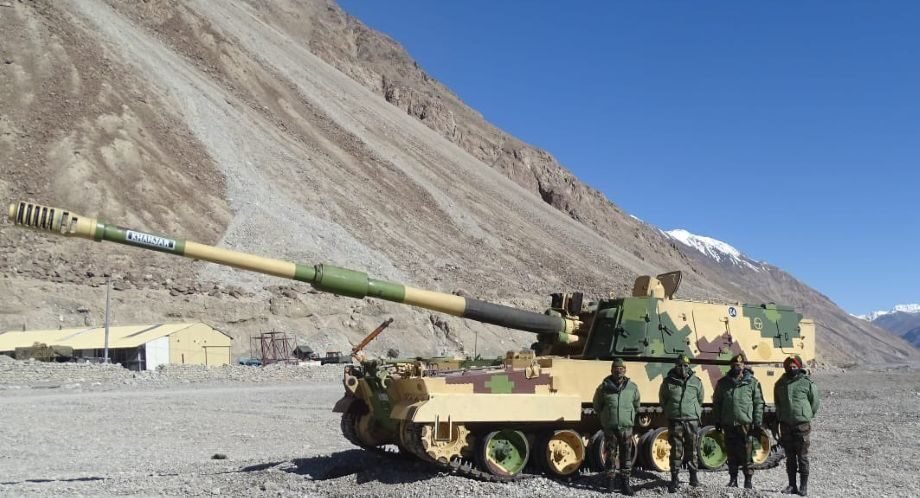
The K9 Vajra-T, manufactured in India by Larsen & Toubro (L&T) in partnership with South Korea’s Hanwha Aerospace, is based on the K9 Thunder self-propelled howitzer. The 155 mm, 52-calibre artillery platform combines substantial firepower with tracked mobility and armoured protection, enabling Army units to reposition quickly after engaging targets. Its mobility and ability to operate with mechanised formations make it an important component of India’s evolving land-warfare strategy.
The Indian Army initially ordered 100 K9 Vajra guns under a contract signed in 2017. A second contract, valued at ₹7,629 crore, was signed in December 2024 for another 100 systems. The proposed addition of 335 guns would potentially expand the planned fleet to 535 howitzers once the earlier orders and the new proposal are accounted for, subject to the final procurement outcome.
Although the system was originally associated with desert operations, its deployment experience has broadened its operational relevance. Following the India-China military standoff in eastern Ladakh, the Army tested the platform in high-altitude conditions and subsequently deployed Vajra units in the region with modifications intended to support operations in extreme cold. This experience has strengthened the case for expanding a platform that has already entered Indian Army service.
The latest proposal also has significant implications for India’s defence manufacturing industry. L&T’s production facilities in Hazira, Gujarat, have established domestic manufacturing capabilities for the system, while successive orders have created opportunities to increase local production and develop Indian suppliers. The new proposal reportedly targets more than 70 per cent indigenous content, although the final localisation level and sourcing arrangements will depend on the terms of the eventual contract.
Alongside the Vajra programme, the Advanced Towed Artillery Gun System (ATAGS) remains an important part of India’s effort to develop advanced artillery through domestic research and manufacturing. Developed by the Defence Research and Development Organisation (DRDO) in collaboration with Indian industry, ATAGS represents a different approach to battlefield firepower. Unlike the tracked and self-propelled K9 Vajra, ATAGS is a towed 155 mm artillery gun designed to be moved by a towing vehicle.
The Ministry of Defence signed a contract worth approximately ₹6,900 crore in March 2025 for 307 ATAGS guns and 327 high-mobility towing vehicles. Bharat Forge and Tata Advanced Systems are associated with the industrial production programme. The agreement marked a significant step towards expanding private-sector participation in the manufacture of indigenous artillery equipment.
Nevertheless, the programme’s next major milestone is the successful completion of the required product-model testing and the subsequent induction of guns into operational service. A February 2027 target has been reported for the first regiment, subject to successful completion of the necessary testing milestones. Until the guns complete the required evaluations and enter service, the programme’s operational progress will remain under scrutiny.
ATAGS has faced development and testing challenges over the years, including questions surrounding weight and performance against certain Army requirements. These issues illustrate the difficulties involved in translating an advanced indigenous design into a fully qualified operational weapon system. At the same time, the programme represents a substantial investment in domestic engineering, technology development and manufacturing expertise.
The comparison between K9 Vajra and ATAGS should not be interpreted as a straightforward contest between competing weapons. The two systems have different configurations and operational roles. A tracked self-propelled howitzer offers protected mobility and the ability to move with mechanised forces, whereas a towed artillery gun provides a different combination of deployment requirements, transport arrangements and tactical flexibility. The Army’s artillery requirements can therefore include both systems as part of a broader force structure.
The wider procurement package approved by the Defence Acquisition Council further demonstrates the scale of India’s planned military modernisation. With approximately 82 per cent of the proposed acquisition value expected to be sourced from Indian industry, the initiative could create opportunities across defence electronics, artillery, military vehicles, aircraft, naval systems and unmanned platforms. However, these opportunities will translate into actual business only as individual proposals move towards tenders and signed contracts.
For India’s artillery sector, the next phase will be defined by execution rather than approval announcements alone. The K9 Vajra proposal must advance through the formal procurement process, while ATAGS must demonstrate that its development and testing milestones can be completed successfully. Their progress will help determine how effectively India can combine proven military platforms with home-grown defence technology.
Ultimately, the expansion of the Vajra fleet and the operational induction of ATAGS represent complementary priorities in India’s artillery modernisation strategy. The proposed Vajra acquisition offers a route to expanding an established capability, while ATAGS provides an opportunity to strengthen indigenous design and production. The pace of procurement, successful testing and delivery will determine how quickly these plans translate into tangible improvements in the Indian Army’s battlefield capabilities.
-

-

-

-