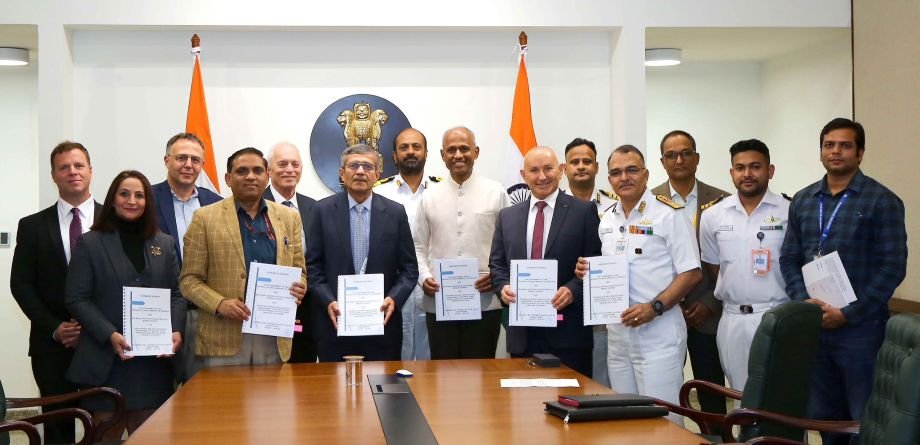
India has taken another important step towards strengthening its naval defence capabilities by signing a ₹1,976.40 crore agreement with Israel Aerospace Industries (IAI) to upgrade the Indian Navy’s Barak Point Defence Missile System. The contract focuses on modernising existing missile systems deployed onboard Indian Navy warships and addressing technological obsolescence to maintain their operational effectiveness.
The Ministry of Defence signed the agreement in New Delhi on November 18, 2026, in the presence of Defence Secretary Rajesh Kumar Singh. The contract has been concluded under the Other Capital Procurement Procedure and covers the upgradation and obsolescence management of the Barak Point Defence Missile System.
Under the agreement, Israel Aerospace Industries will undertake a comprehensive upgrade of the system’s hardware and software. The modernisation programme is expected to introduce enhanced features and improve the air-defence capabilities of Indian naval platforms. It will also address issues associated with ageing technology and outdated components that can affect the long-term reliability and maintenance of defence equipment.
The Barak Point Defence Missile System plays an important role in protecting Indian Navy warships against aerial threats. As a ship-based air-defence system, it provides protection against hostile airborne targets, including incoming missiles and aircraft. Such systems are particularly important for naval vessels operating in challenging maritime environments, where threats can emerge with limited warning.
Modern naval operations increasingly require reliable defence against evolving aerial threats. Advances in missile technology, low-altitude attack profiles and the growing use of unmanned aerial systems have made ship-based air-defence capabilities an important part of naval security. Maintaining and upgrading existing missile systems can help warships remain better prepared to respond to changing operational requirements.
The latest agreement also highlights the importance of obsolescence management in maintaining military equipment. Over time, electronic components, hardware assemblies and software technologies can become outdated or difficult to replace. Upgrading these elements helps maintain equipment availability and supports the continued use of existing defence systems without requiring an immediate complete replacement.
For the Indian Navy, the programme is expected to strengthen the defensive capabilities of its existing naval platforms while supporting the long-term serviceability of the Barak system. However, the Ministry of Defence has not publicly disclosed the number of warships covered by the contract, the detailed technical specifications of the upgrades or the expected completion schedule.
India and Israel have maintained a longstanding defence partnership, particularly in missile development and air-defence technologies. Their cooperation also includes the Barak-8 family of surface-to-air missile systems, developed through collaboration between Israel Aerospace Industries and India’s Defence Research and Development Organisation (DRDO).
It is important to distinguish the latest agreement from the separate Barak-8 programme. The ₹1,976.40 crore contract specifically concerns the existing Barak Point Defence Missile System deployed on Indian Navy ships and focuses on its modernisation and obsolescence management.
The agreement reflects India’s continued efforts to maintain and strengthen its maritime defence infrastructure through the modernisation of existing military platforms. By upgrading the Barak missile systems, the Indian Navy aims to ensure that its warships retain effective protection against evolving aerial threats while maintaining the operational readiness of its fleet.