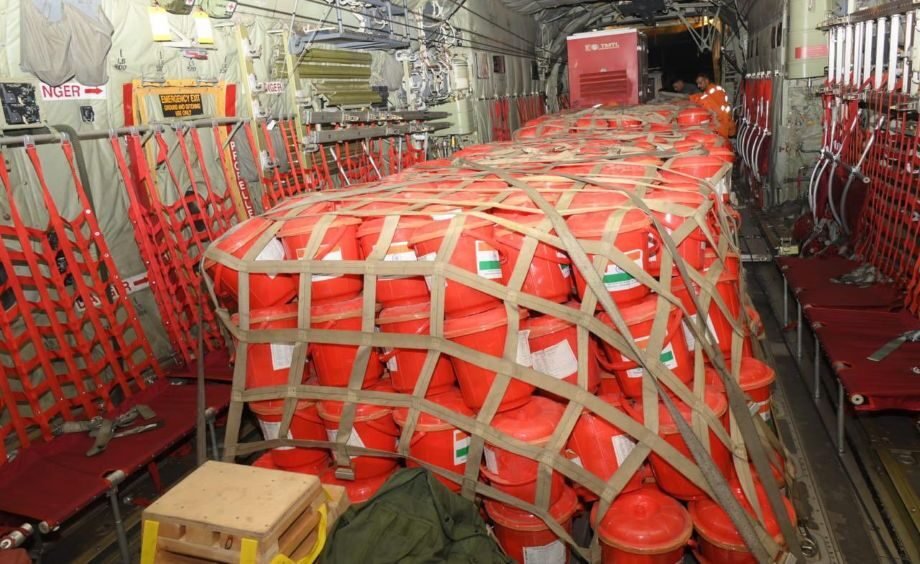
India has moved quickly to assist Nepal after severe flash floods caused extensive disruption and casualties in several parts of the country. In response to the unfolding humanitarian situation, India has sent 10 tonnes of emergency relief supplies and essential medicines to support people affected by the disaster.
The assistance was airlifted by an Indian Air Force C-130J Super Hercules transport aircraft, providing a rapid means of moving critical supplies to Nepal. The consignment contains a range of items required during the initial stages of disaster response, including temporary shelters, blankets, hygiene kits, solar lamps and medicines.
The airlift forms part of India’s wider Humanitarian Assistance and Disaster Relief (HADR) efforts and highlights the country’s willingness to provide immediate support to neighbouring nations during major natural disasters.
The use of the C-130J is particularly significant because air transport can deliver emergency supplies rapidly when flooding affects roads, bridges and other ground transportation infrastructure. The aircraft gives the relief mission the flexibility needed to move essential cargo directly and efficiently.
External Affairs Minister S. Jaishankar announced India’s relief initiative and expressed solidarity with Nepal during the crisis. He also conveyed condolences to those who lost family members in the floods and reiterated India’s commitment to assisting the neighbouring country.
Prime Minister Narendra Modi also contacted Nepal’s Prime Minister Balendra Shah to convey India’s condolences following the loss of lives. During the interaction, Modi assured Nepal of India’s readiness to extend all possible humanitarian assistance and stressed the importance of coordination between the two countries during the ongoing rescue and relief efforts.
The relief operation comes as Nepal’s emergency agencies continue working to assist communities affected by flooding. In disaster-hit areas, access to basic necessities can become difficult when transport networks and local infrastructure are damaged, making timely delivery of food, medical supplies and temporary shelter particularly important.
India’s deployment of an IAF C-130J demonstrates how military airlift assets can support civilian disaster-response efforts beyond their conventional defence role. Such aircraft can carry substantial quantities of relief material and reach locations where normal logistics networks may be severely constrained.
The latest assistance also reflects the close ties between India and Nepal and their history of cooperation during humanitarian emergencies. By rapidly mobilising relief material and medical supplies, India is providing practical support to Nepal while its authorities continue their rescue and recovery operations.
As Nepal works to recover from the impact of the floods, the Indian airlift is expected to help meet some of the immediate needs of affected communities and strengthen ongoing humanitarian relief efforts.
-
-

-
-