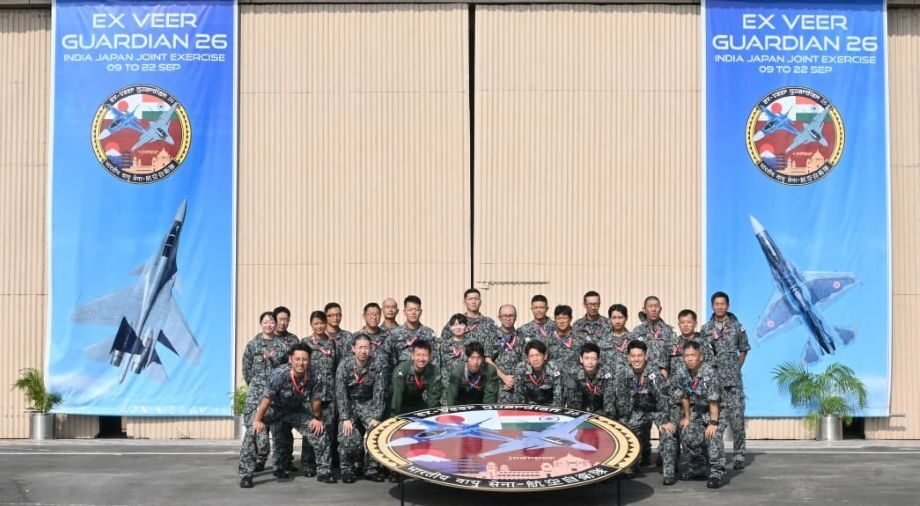
India and Japan have stepped up their air-force cooperation with the commencement of Exercise Veer Guardian 2026 at Air Force Station Jodhpur. The bilateral exercise, being conducted from September 9 to September 22, brings Japanese F-2A fighter aircraft to India for joint training with some of the Indian Air Force’s (IAF) frontline combat platforms.
The Japanese Air Self-Defense Force (JASDF) has deployed F-2A fighters for the exercise, while the IAF is taking part with Tejas, Su-30MKI and Rafale aircraft. The combination provides both sides with an opportunity to conduct realistic air operations involving different fighter platforms and operational procedures.
The arrival of the Japanese contingent at Jodhpur represents an important stage in preparations for the exercise. JASDF C-2 transport aircraft have also been involved in moving personnel and equipment required for the deployment. The Japanese participation includes personnel from the service’s 8th Air Wing based at Tsuiki Air Base.
Veer Guardian 2026 is designed to go beyond routine flying activities. The participating air forces will engage in mission planning, operational discussions and professional exchanges intended to improve coordination between their personnel. Engineering and aerospace safety-related interactions are also part of the exercise, providing opportunities for the two sides to exchange technical and operational experience.
For the IAF, training alongside the JASDF F-2 offers an opportunity to gain greater familiarity with a fighter platform that has evolved from Japan’s own aerospace and defence requirements. The exercise can also provide valuable experience in planning and executing missions involving aircraft with different capabilities, operating philosophies and support arrangements.
The Indian participation further highlights the range of combat aircraft available to the IAF. Tejas represents India’s indigenous fighter development programme, while the Su-30MKI and Rafale provide advanced multirole combat capabilities. Operating these aircraft in a bilateral environment with Japanese F-2s creates a demanding training setting for aircrew and supporting personnel.
The current exercise is also significant in the broader context of India-Japan defence relations. Both countries have steadily expanded military cooperation through exercises and professional exchanges involving their armed forces. Air-force engagements such as Veer Guardian provide a practical platform for developing familiarity between the two services and improving their ability to operate together.
The first edition of Veer Guardian was conducted in Japan in 2023. Bringing the exercise to Indian territory in 2026 marks a further development in the bilateral air partnership and gives Japanese personnel an opportunity to operate from an Indian air base while training with IAF aircraft.
As the exercise progresses, flying activities and professional interactions at Jodhpur are expected to strengthen tactical understanding and interoperability between the two air forces. Veer Guardian 2026 therefore serves not only as a fighter exercise but also as another step toward deeper operational cooperation between India and Japan.
-

-

-

-