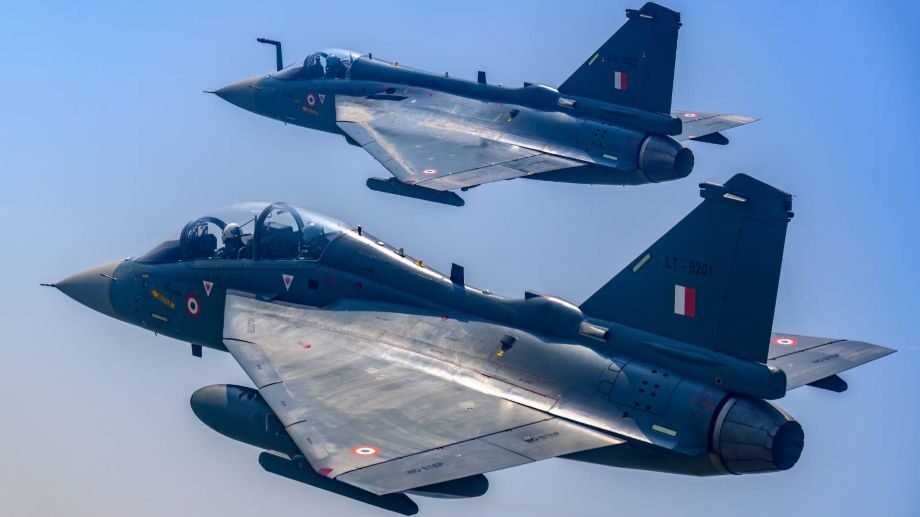

Hindustan Aeronautics Limited (HAL) is targeting annual production of 30 Tejas MK-1A light combat aircraft, backed by General Electric’s continued supply of F404 turbofan engines, according to industry sources familiar with the programme.
The production ramp-up marks a significant acceleration from current delivery rates and reflects HAL’s confidence in stabilising the indigenous fighter jet’s manufacturing ecosystem as the Indian Air Force continues inducting the aircraft into operational squadrons.
The Tejas MK-1A is the operational variant of India’s Light Combat Aircraft (LCA) programme. It incorporates aerodynamic refinements, improved avionics integration, and enhanced combat capability over the initial Tejas configuration, making it a more capable multirole fighter for the Indian Air Force.
General Electric’s F404 engine, a mature turbofan optimised for fighter applications, powers both the MK-1 and MK-1A variants. Securing sustained engine supply is critical to HAL’s production timeline, as engine manufacturing and qualification represent bottleneck activities in fighter aircraft production. GE’s commitment to supply supports HAL’s factory throughput in Bengaluru.
The 30-aircraft-per-year target aligns with the Indian Air Force’s stated requirement for approximately 120 Tejas aircraft to bridge the fighter squadron deficit created by the retirement of older MiG-21 and MiG-27 platforms. At full production, HAL could deliver the bulk of the IAF’s planned Tejas fleet within four to five years of maintaining this production rate.
The MK-1A variant carries a 20 mm M61A1 Vulcan cannon, air-to-air missiles including the indigenous Astra beyond-visual-range missile and the Derby missile, along with provisions for precision-guided air-to-ground munitions. Avionics upgrades include an Active Electronically Scanned Array (AESA) radar, a helmet-mounted display, and integration with India’s tactical data link architecture.
HAL’s production acceleration also reflects India’s broader Make in India and Atmanirbhar Bharat objectives in defence manufacturing. The Tejas programme demonstrates India’s capability to design, develop, and serially produce a modern fighter aircraft, reducing dependence on imported platforms while strengthening the country’s indigenous aerospace industrial base.
The production surge will require concurrent scaling of supply chain capabilities across hundreds of vendors, including precision machining, composites manufacturing, and avionics integration. Quality assurance and flight-test validation will remain critical as HAL increases production to meet the Indian Air Force’s operational requirements.