India’s ambitious human spaceflight programme, Gaganyaan, could face another adjustment to its launch schedule, with the first uncrewed mission now unlikely to take place before February 2027. The development comes as the Indian Space Research Organisation (ISRO) continues additional technical evaluations, simulations and safety checks ahead of the country’s first major human spaceflight demonstration.
The Gaganyaan G1 mission was previously targeted for December 2026. However, according to a report published by India Today on November 20, 2026, officials familiar with the programme have indicated that the launch may be postponed to February 2027. The reported delay reflects ISRO’s emphasis on ensuring the reliability of critical spacecraft systems before proceeding with the mission.
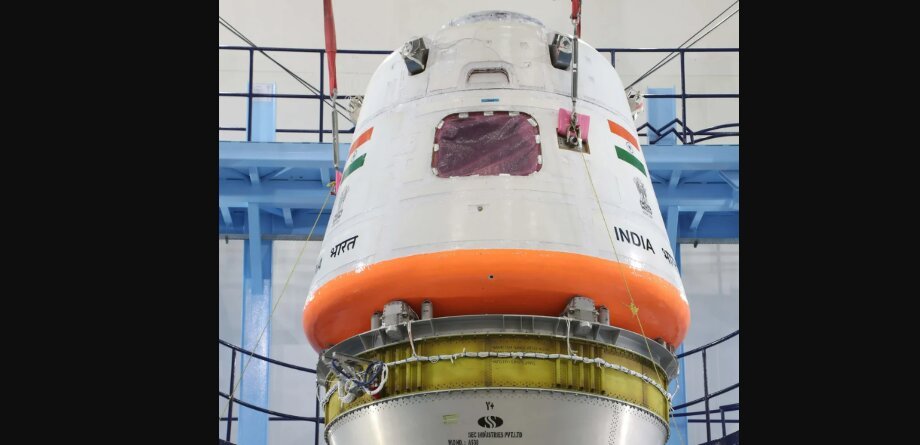
Sources cited in the report indicated that approximately 80 per cent of the overall work has been completed. The remaining activities include additional simulations, technical assessments and validation procedures required before the spacecraft can be cleared for flight. The Crew Module, which will carry ISRO’s humanoid robot Vyommitra, has reportedly received clearance and is expected to be transported to the Satish Dhawan Space Centre in Sriharikota for further launch preparations.
Once the Crew Module reaches the launch facility, integration activities with the Human-Rated Launch Vehicle Mark-3 (HLVM3) are expected to begin. The rocket, developed specifically for India’s human spaceflight programme, is a modified version of ISRO’s LVM3 launch vehicle. It has been designed with additional safety features and systems necessary to support future astronaut missions.
The first uncrewed Gaganyaan flight, designated G1, will be an important demonstration of India’s ability to operate a human-rated spacecraft. Unlike a conventional satellite launch, the mission requires the successful coordination of several interconnected systems, including the launch vehicle, Crew Module, avionics, environmental control systems and recovery mechanisms.
A major component of the mission will be Vyommitra, ISRO’s half-humanoid robot developed to simulate selected human functions during spaceflight. Its presence will help engineers evaluate spacecraft performance and monitor important parameters during the mission. Data collected during the flight will contribute to improving the systems and procedures required for future crewed operations.
The programme has already achieved several important technological milestones. In an official statement presented to the Rajya Sabha on August 6, 2026, Union Minister of State for Science and Technology Dr Jitendra Singh confirmed that the development and ground testing of the HLVM3 propulsion stages and structures had been completed. He also highlighted progress in crew escape systems, crew and service module propulsion, thermal protection and deceleration technologies.
ISRO has also successfully conducted important tests associated with the Crew Escape System and parachute-based deceleration systems. These technologies are essential for ensuring astronaut safety during different phases of a mission, particularly in emergency situations and spacecraft recovery operations.
The government has outlined a roadmap involving three uncrewed missions before India’s first crewed orbital flight. These missions will provide opportunities to validate critical technologies and demonstrate the reliability of the complete human spaceflight architecture.
Although a possible shift to February 2027 could extend the programme’s timeline, the additional testing reflects the complexity of developing an indigenous human spaceflight capability. ISRO must demonstrate that every major system can operate reliably under demanding spaceflight conditions before astronauts are placed aboard the spacecraft.
For India, Gaganyaan represents a major step towards becoming a nation with independent human spaceflight capabilities. Its successful completion will also strengthen the technological foundation for future space exploration initiatives, including the planned Bharatiya Antariksh Station.
While an official revised launch date has not yet been confirmed in the cited government announcement, the latest reports suggest that ISRO is prioritising mission readiness and astronaut safety over meeting the earlier December 2026 target.
-

-

-

-