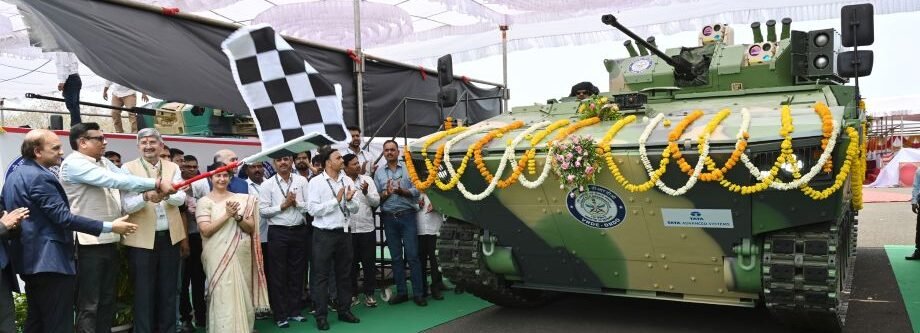
India’s indigenous defence development programme has achieved an important milestone with the progress of the Defence Research and Development Organisation’s (DRDO) Vikram VT-21 Advanced Armoured Platform. The wheeled variant, designed to meet the Indian Army’s future operational requirements, is progressing through its evaluation and development process as India works towards strengthening its domestic armoured vehicle capabilities.
Developed by DRDO’s Vehicles Research and Development Establishment (VRDE), the Vikram VT-21 programme includes both tracked and wheeled configurations. The platforms are being developed to address the requirements of a Futuristic Infantry Combat Vehicle (FICV) and an Armoured Personnel Carrier (APC). The project represents an important step towards replacing ageing combat vehicle capabilities with modern, indigenous solutions.
The development programme involves collaboration with Indian defence industry partners, including Tata Advanced Systems Limited (TASL) and Bharat Forge Limited (BFL). Their participation reflects the growing role of private-sector manufacturers in India’s military vehicle development ecosystem. The wheeled and tracked platforms were officially flagged off at VRDE, Ahilyanagar, on April 25, 2026, in the presence of DRDO Chairman Dr Samir V. Kamat.
The Vikram VT-21 features an indigenously developed 30 mm crewless turret designed to improve battlefield firepower while reducing the exposure of personnel operating the weapon system. The platform is also configured with a 7.62 mm PKT machine gun and provisions for integrating third-generation anti-tank guided missiles. These capabilities are intended to provide greater flexibility during infantry support and armoured combat operations.
Protection and mobility are equally important aspects of the vehicle’s design. The platform incorporates advanced armour solutions, blast protection technologies and a high-power diesel engine paired with an automatic transmission. Its design aims to provide improved mobility across challenging terrain while offering enhanced protection against battlefield threats. The wheeled configuration is particularly relevant for operations requiring faster road movement and deployment across different operational environments.
According to information published in defence-related reporting, the Vikram VT-21 platforms had cleared the Technical Evaluation Committee stage by the end of April 2026. However, technical evaluation clearance should not be confused with final acceptance or induction into the Indian Army. Further development activities, user trials and evaluation by the Army remain important stages before any decision on operational deployment.
One of the programme’s broader objectives is to strengthen India’s self-reliance in advanced land-based military systems. The platform reportedly has approximately 65 per cent indigenous content, with plans to increase the figure to around 90 per cent. Greater domestic manufacturing could reduce dependence on foreign suppliers while supporting Indian defence companies and technology developers.
The Vikram VT-21 programme also holds significance in the context of the Indian Army’s requirement for modern infantry combat vehicles. As battlefield operations increasingly demand improved protection, mobility, surveillance and integrated firepower, indigenous platforms such as Vikram VT-21 could play an important role in meeting future requirements.
Although the vehicle has made progress through its development milestones, its eventual induction will depend on successful completion of the remaining trials, user assessments and procurement procedures. The programme nevertheless highlights India’s growing capabilities in designing and developing advanced armoured platforms through cooperation between DRDO and domestic defence manufacturers.
-

-

-

-