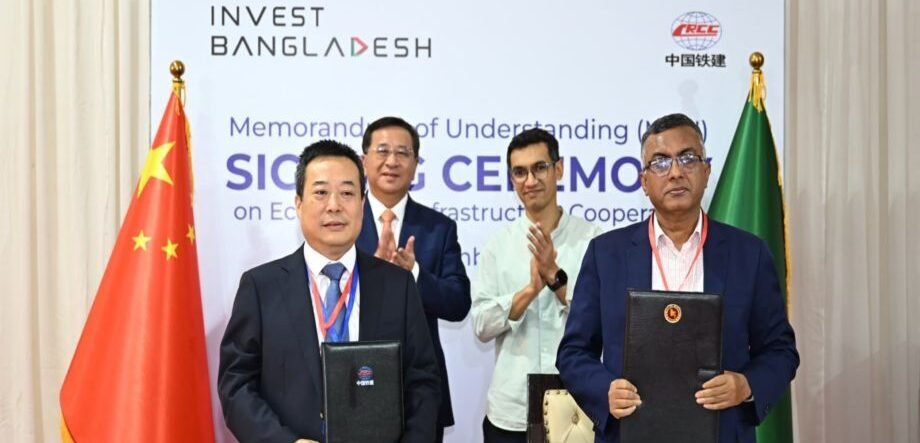
Bangladesh and China have taken another step towards strengthening their economic partnership after signing a new memorandum of understanding (MoU) focused on investment cooperation and infrastructure development. The agreement was signed on November 5, 2026, at Mongla Port in Bagerhat, Bangladesh, in the presence of Prime Minister Tarique Rahman.
The MoU was concluded between Invest Bangladesh and China Railway Construction Corporation (CRCC), one of China’s major state-owned engineering and construction groups. Saleh Ahmed, Member of Invest Bangladesh’s Industrial Zone Division, signed the agreement on behalf of Bangladesh, while Li Chongyang, Chairman of China Civil Engineering Construction Corporation (CCECC), signed on behalf of the Chinese side. CCECC operates as a subsidiary of CRCC.
The agreement establishes a framework for identifying potential investment opportunities across several important sectors of the Bangladeshi economy. These include transportation and logistics, renewable energy, industrial infrastructure, environmental projects, waste-to-energy initiatives, railway equipment assembly and vocational training. The two sides will also explore possible investment opportunities in state-owned enterprises operating in the chemical, sugar, food processing, steel and engineering industries.
A key objective of the arrangement is to encourage Chinese companies to participate in Bangladesh’s infrastructure and industrial development. Invest Bangladesh will help facilitate communication between prospective investors and relevant government agencies, as well as public and private sector stakeholders. This coordination is expected to make it easier to identify suitable projects and support future investment discussions.
However, the MoU does not represent a confirmed financial investment or provide CRCC with preferential investment rights. Instead, it establishes a non-binding framework under which both parties can examine potential projects and develop opportunities for future cooperation.
Prime Minister Tarique Rahman attended the signing ceremony alongside Invest Bangladesh Chairman Ashik Chowdhury and CRCC Chairman Dai Hegen. Senior representatives from both countries also participated in discussions concerning economic cooperation and investment opportunities. The agreement follows an earlier meeting between the Bangladeshi Prime Minister and the CRCC chairman at the World Economic Forum’s Summer Davos event in 2026.
The timing of the agreement is particularly significant for Mongla, which is an important port and commercial gateway in southwestern Bangladesh. During the same visit, the Prime Minister laid the foundation stone for two new container jetties and associated infrastructure as part of the Mongla Port expansion and modernisation project. CCECC is responsible for implementing the construction of these two jetties.
The proposed Bangladesh-China Mongla Economic Zone is another important element of the growing partnership. The designated site covers approximately 110 acres, and a separate memorandum concerning the economic zone was signed in Beijing on June 25, 2026. The latest agreement could help create additional opportunities for industrial investment and improve the region’s commercial potential.
For Bangladesh, attracting foreign investment remains an important part of its broader economic development strategy. Cooperation with Chinese companies could support infrastructure improvements, strengthen domestic manufacturing capabilities, encourage technology and skills development, and create employment opportunities.
The government aims to generate 10 million jobs by 2030 and build a $1 trillion economy by 2034. Although achieving these targets will require substantial investment and long-term economic reforms, partnerships such as the latest Bangladesh-China agreement could contribute to those ambitions.
The November 5 agreement therefore represents another step in Bangladesh’s efforts to expand international economic cooperation and attract investment into strategic sectors. Its actual impact will depend on the projects identified, investment decisions made and their successful implementation in the coming years.
-

-

-

-