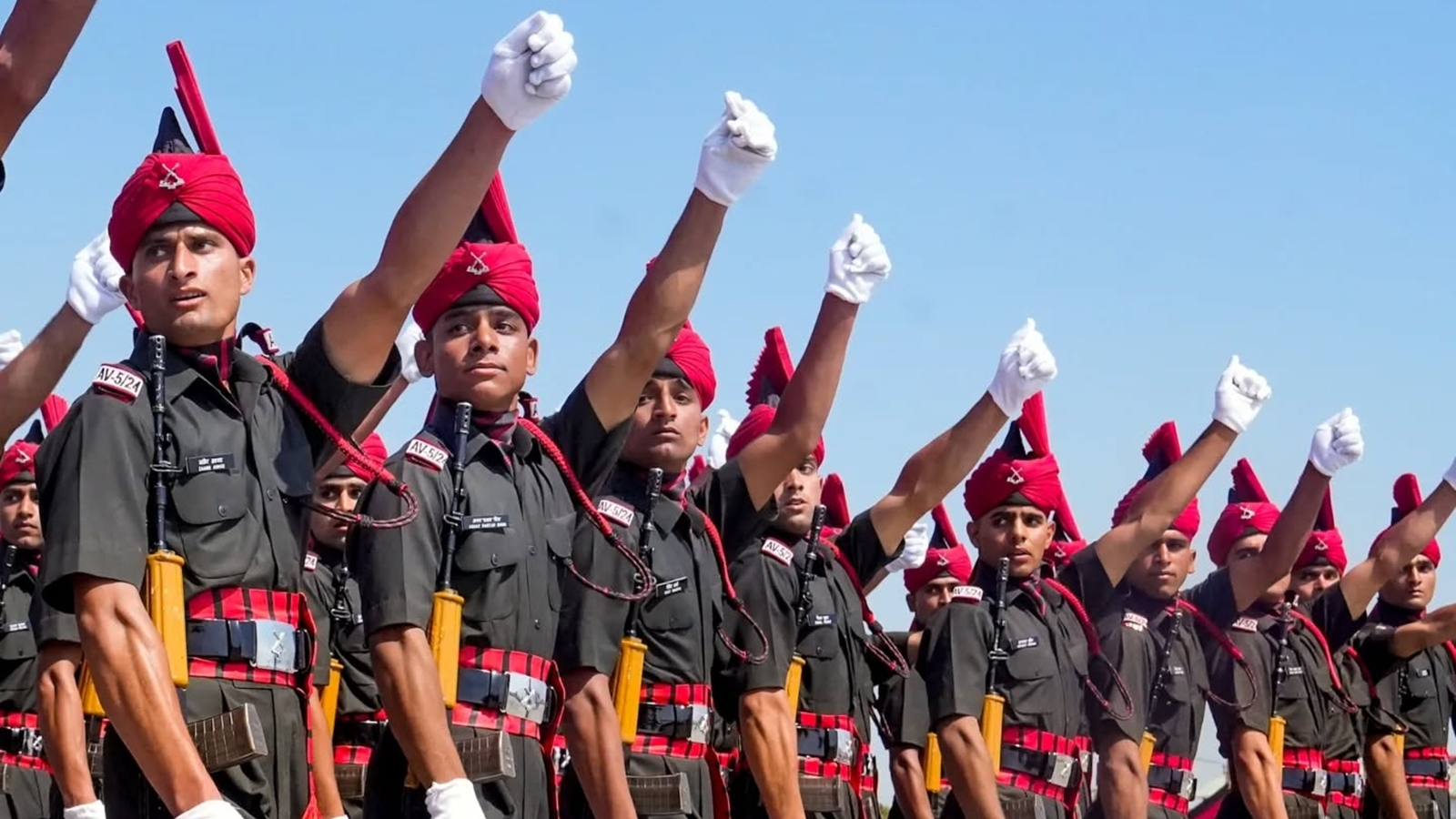
India’s Armed Forces have formally sought a larger proportion of Agniveers to be retained beyond their four-year service tenure, signalling a shift in how the military intends to operationalise the Agnipath scheme.
The request reflects growing confidence in the scheme’s ability to inject youth, fitness, and digital literacy into the force structure while managing long-term pension liabilities. The Agnipath programme, launched in 2022, recruits personnel aged 17.5 to 21 for a fixed term of four years with no inherent pension entitlement, followed by a window for up to 25 per cent of Agniveers to transition into permanent cadre.
The scheme was designed to address two structural challenges facing Indian defence: the need to reduce the average age profile of enlisted personnel and to contain the mounting defence pension bill, which had grown to over 2 lakh crore annually. By recruiting large cohorts for short tenure, the military aimed to create a leaner, more agile force while deferring permanent establishment costs.
Initial rollout faced significant resistance from aspirants and civil society, with protests in Bihar and other states in 2022. However, subsequent recruitment cycles demonstrated steady applicant numbers and improved force cohesion metrics. Agniveers deployed in the 2022-2023 Kargil-region exercises and internal security operations in Kashmir showed better physical conditioning and faster adaptation to digital weapon systems compared to traditional jawans of equivalent service length.
The Armed Forces’ push for higher retention now reflects operational learning. A larger permanent cadre drawn from Agniveers would preserve accumulated experience while maintaining the scheme’s foundational cost discipline. Current retention stands at the mandated 25 per cent ceiling; increasing this threshold would require Defence Ministry and Cabinet approval.
This development also carries implications for recruitment cycles. Higher retention would reduce the annual intake requirement, lowering the overall volume of recruitment boards while concentrating resources on quality assessment. The Indian Army, which bears the largest recruitment burden, stands to benefit most from such recalibration.
The Ministry of Defence has not yet announced policy changes. However, defence analysts note that the Services’ formal request strengthens the case for scheme modifications as the first Agnipath cohort approaches the end of their tenure in 2026. Any increase in retention thresholds would need to be balanced against the scheme’s original fiscal objectives and the need to continue offering pathway opportunities for fresh applicants.
-

-

-

-